Yaya's Birding Tours

Extend your trip

Birding in Senegal

Senegal surrounds The Gambia on three sides, which makes it the most natural cross-border extension for a Gambia birding trip. The national checklist runs to about 700 species (698 on the Clements-based list used by Wikipedia), and a specialist 17-day Senegal-only tour recorded 345 of them in 2026. It adds a large block of birds that are scarce or absent in The Gambia: Sahelian desert-edge species in the far north, big concentrations of Palearctic waterbirds at Djoudj, the White-crested Tiger Heron and the Scissor-tailed Kite roost in the Saloum Delta, and the Sudanian and Guinean birds of the far south-east and the Casamance.

For a visiting birder the appeal is variety within reach. The Saloum Delta around Toubacouta is a short drive across the border from The Gambia's north bank; Fathala Wildlife Reserve is only about 5 km beyond the Karang border post and Toubacouta is about 17 km further north. Wassadou and Niokolo-Koba National Park, a well-known and reliable Egyptian Plover area, are about four hours by road from the Gambian border crossing at Sabi, according to one birding reference. Djoudj, Podor, the Dakar lagoons and the Kedougou region are much further away and need several days each, so they are usually done on a dedicated Senegal trip rather than as an add-on.

Yaya runs two cross-border tours that already include Senegal: a Saloum Delta tour (Toubakouta, the Kousmar kite colony, Fathala area) and an Eastern Senegal tour (Wassadou and Niokolo-Koba). This guide covers those and the wider country so you can decide what to ask for. Visa, fee and flight details change often, so time-sensitive items below carry the date they were checked (October 2026); please confirm with official sources before you travel.

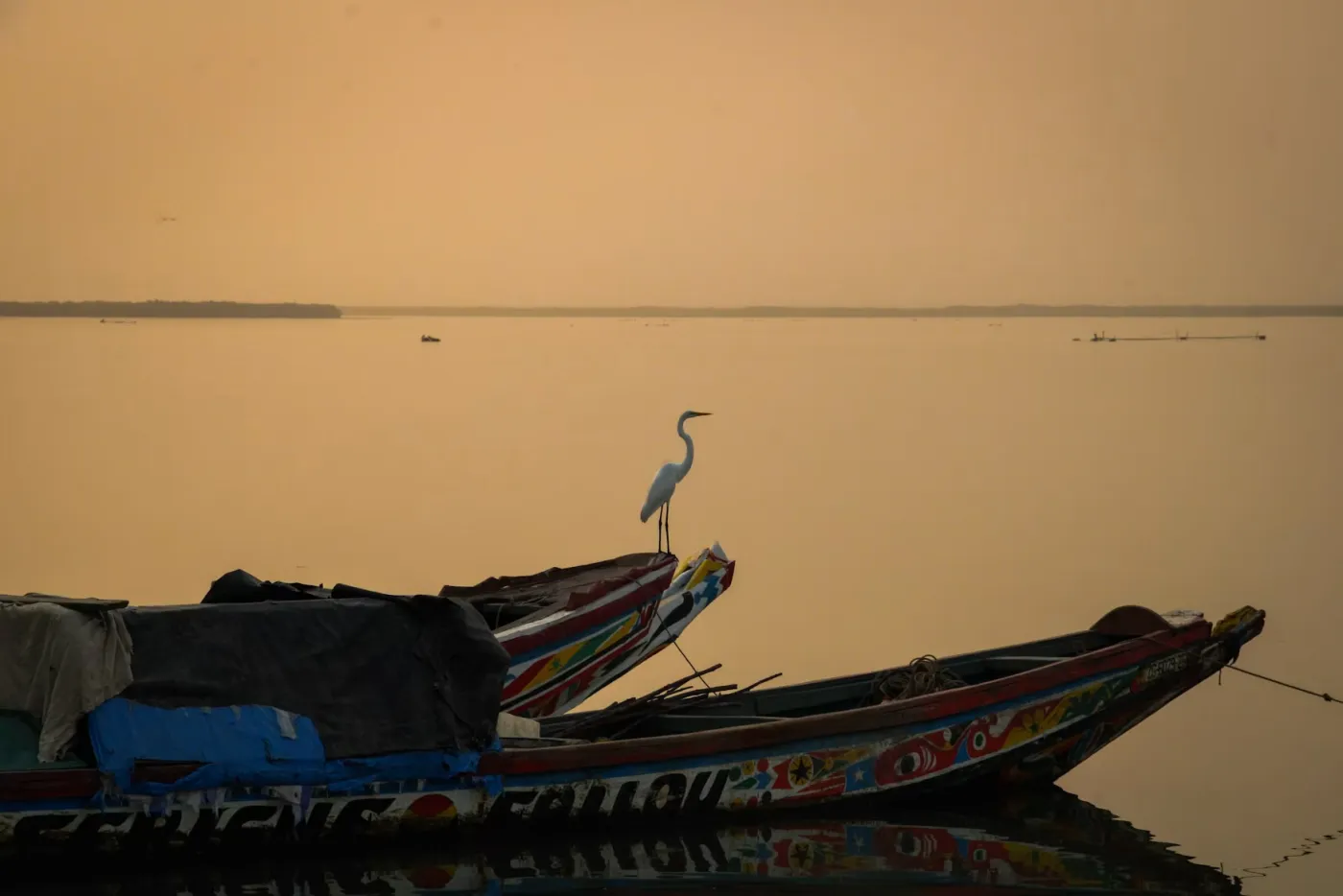
A Great Egret perched on the bow of a painted pirogue at dusk on a Senegalese river

At a glance

Best time to go
Late November to February for Palearctic migrants plus residents; late January to mid-February is when specialist tour operators run their Senegal trips (checked Oct 2026).
Ideal trip length
Yaya's two tours each include about 3 nights in Senegal. A Saloum Delta add-on works well at 3 to 5 nights, Wassadou and Niokolo-Koba from eastern Gambia at 3 to 5 nights, and specialist operators run a full Senegal loop including Djoudj and Kedougou over about 17 days.
Species total (approx.)
About 700 on the national list (698 on the Clements-based list used by Wikipedia). A specialist 17-day tour recorded 345 species in early 2026 (recent trip report).
Getting there from The Gambia
By road. Either the Banjul to Barra ferry and then the Amdalai (Gambia) / Karang (Senegal) border post, or the Senegambia Bridge at Farafenni and the Keur Ayib / Kerr Ali border post, which avoids the ferry. Banjul to Dakar is commonly quoted at 6 to 9 hours including ferry and border formalities (commercial guide).
Visa/entry for US/UK/EU citizens
No visa is needed for tourist stays of up to 90 days for UK, US, Canadian, Australian and EU passport holders, according to the UK and Canadian governments' entry pages, the US Embassy and Wikipedia's visa policy summary. Passport valid 6 months beyond arrival (some US sources quote 9 months, so check with your airline), plus onward ticket and accommodation details (checked Oct 2026).
Currency
West African CFA franc (XOF), pegged to the euro at 655.957 per EUR. Carry some cash before crossing.
Languages
French is official; Wolof is spoken almost everywhere, with Sereer, Pulaar and Mandinka regionally. Mandinka-speaking guides from The Gambia are useful in the south and east.
Time zone
UTC+0 (same as The Gambia, no daylight saving).
Vaccinations/health headline
A yellow fever certificate is required if you arrive from a country with risk of transmission, and The Gambia is on the list; the CDC also recommends vaccination for all travellers aged 9 months and over. Malaria is present (chloroquine-resistant). See your travel clinic well ahead (checked Oct 2026).
Electricity
230 V, 50 Hz. Two-pin European plugs (types C and E) are standard; The Gambia uses UK-style three-pin plugs (type G), so carry both adaptors.
Typical daily budget note
Highly variable. Village campements near Djoudj are reported at around 21,000 CFA full board per person, while the safari-style tented NiokoLodge lists 95,000 CFA per person per night on its own price list. Park fees are small in comparison; confirm current amounts with Yaya.

When to go

Late November to February, when Palearctic winter migrants overlap with residents and the weather is at its most comfortable; Djoudj is at its best from December to mid-February, and specialist operators run their Senegal tours from late January to mid-February. Seabird passage at Dakar peaks from early October to mid-November, and the Scissor-tailed Kite roost at Kousmar is active from about November to March.

PeriodConditionsBirding
November–FebruaryDry, sunny and relatively cool, with cooler mornings and evenings; the harmattan wind can bring dust haze. This is the dry season (Wikivoyage gives December to April as the dry months).Prime season. Djoudj holds its largest concentrations of pelicans, flamingos, ducks and waders; Aquatic Warbler winters in the Senegal delta; the Scissor-tailed Kite and Lesser Kestrel roost at Kousmar is in place; Wassadou river boat trips are productive for Egyptian Plover, finfoot and bee-eaters. Specialist tours run late January to mid-February.
March–MayHot and increasingly humid towards May, with temperatures rising inland. Nesting terns and gulls at Langue de Barbarie are best from February to late May.Spring migration brings waders and passerines through the coast and Dakar lagoons; breeding colonies of terns and gulls are active at Langue de Barbarie. Many Palearctic birds leave Djoudj by May, so go earlier if pelicans and ducks are the priority.
June–September/OctoberRainy season (roughly June to September, a little later in some years). Laterite and minor roads can flood or become impassable without a 4x4, notably south of Joal on the way to Palmarin and on tracks in Djoudj and Niokolo-Koba.Few Palearctic migrants. Intra-African migrants and breeding residents arrive (Popenguine is notable for its wet-season transformation) and Sahelian birds breed. Seabird passage off Dakar starts to build from September. This is a low-season option for experienced birders only, and access should be checked locally.
October–mid-NovemberEnd of the rains, green landscapes, hot and humid, with roads still drying out in places.Best window for seawatching from the Ngor and Almadies headlands near Dakar (Cory's and Cape Verde Shearwaters, skuas, terns, storm-petrels). First Palearctic waterbirds are arriving at Djoudj and the Saloum Delta.

Target birds and where to find them

SpeciesWhereNotes
Great White PelicanDjoudj National Bird Sanctuary; Saloum Delta; Langue de BarbarieDjoudj hosts a large breeding colony on a pelican island reached by boat; peak around December to January.
Greater FlamingoDjoudj; Palmarin; Kaolack salt lakeWater level dependent, so numbers vary by year and month.
Black Crowned CraneDjoudj and the Trois Marigots area near Saint-LouisA regular target on specialist tours in January to February; also listed on Yaya's Kousmar day.
Marbled DuckDjoudjFound among the many wintering ducks at Djoudj; reported on specialist trips.
Aquatic WarblerDjoudj and the Senegal River deltaDjoudj is described as the most important wintering site known for this globally threatened warbler (Wikipedia); it is hard to see and needs local expertise.
Lesser JacanaTrois Marigots and Djoudj areaSeen on specialist tours (2025 tour); best with a local guide who knows the current marshes.
River PriniaTrois Marigots near Saint-Louis; Djoudj edgeA target for the northern leg of specialist tours.
Allen's GallinuleTrois MarigotsUsually found among the lily-covered marshes.
Golden NightjarPodor region on the Mauritanian borderRanked the top bird of recent specialist trips (2025 and 2026) (roosting birds seen in daytime near Podor); needs local expertise in remote desert-edge country.
Cricket WarblerPodor and Richard Toll areaA Sahelian specialty rarely reachable from The Gambia.
Sennar Penduline TitRichard TollAlso listed as a target for a 2026 specialist tour.
Little Grey WoodpeckerPodor regionAnother Sahel-edge speciality.
Scissor-tailed KiteKousmar Island, Saloum Delta near Kaolack; also on Yaya's Saloum tourRecent trip reports (2025 and 2026) describe up to 36,000 kites and 28,000 Lesser Kestrels at the peak of the roost; counts vary greatly between years and seasons.
Lesser KestrelKousmar roostRoosts with the kites; numbers vary hugely between reports.
White-crested Tiger HeronMangrove creeks near Toubacouta, Saloum DeltaUsually sought by boat at low tide with a local boatman; found on a 2026 tour and on Yaya's Saloum boat day.
West African Crested TernSaloum Delta coastListed in specialist trip reports as a Saloum target.
Mangrove SunbirdSaloum Delta mangroves; also Gambian mangrovesAlso on Yaya's Saloum itinerary.
Audouin's GullPalmarin and the Saloum coastPalmarin has held the highest wintering counts in Senegal (a maximum of 522 in January 1997, so older data).
Egyptian PloverGambia River boat trips from Wassadou, Niokolo-Koba edgeWassadou is widely regarded as one of the most reliable places in Africa to see it (prolonged views were reported in 2026); it is also found on the Gambian side in Yaya's itineraries.
African FinfootGambia River at Wassadou; also Saloum DeltaSeen from boats at Wassadou in trip reports; best on a quiet early boat trip.
Northern Carmine Bee-eaterGambia River at WassadouColonies of Red-throated and Northern Carmine Bee-eaters along the river bank at Wassadou.
Pel's Fishing OwlGambia River at WassadouListed in a 2026 trip report (ranked among the top birds of the trip); a night excursion with a boatman is usually needed.
Stone PartridgeKedougou and Bandafassi cliffs, south-east SenegalListed on 2023 and 2026 trip reports.
White-crested HelmetshrikeNiokolo-Koba woodlands; Fathala areaAlso listed in Yaya's Eastern Senegal itinerary.
Mali FirefinchKedougou and Dindefelo, south-east SenegalA range-restricted bird; a main reason for tours going to the far south-east.
Neumann's StarlingKedougou regionFound alongside Mali Firefinch near Dindefelo.
Turati's BoubouForêt de Djibelor and other Casamance forest patchesReported in a 2023 trip report; village permission may be needed.
Capuchin BabblerCasamance Ecopark, DiemberingFrom a 2023 trip report; Capuchin Babbler also occurs in The Gambia (Yaya lists it on his Kartong day).

Key birding sites

Greater Flamingos resting in shallow water at Djoudj National Bird Sanctuary

Saint-Louis region, far northern Senegal

Djoudj National Bird Sanctuary

A 16,000-hectare floodplain wetland in the Senegal River delta, a UNESCO World Heritage Site (1981) and Ramsar site (11 July 1977), and the headline birding destination in the country. About 395 species have been recorded, and wintering birds are estimated at between roughly 1.5 million and 3 million. The standard visit is a boat trip of about two hours up the Djoudj branch, passing a Great White Pelican breeding island, with flamingos, ducks, spoonbills, African Fish Eagle and cormorants along the way, plus Black Crowned Crane and Marbled Duck on good days. It is much further north than any Gambian site, so it is normally part of a dedicated Senegal trip combined with Saint-Louis and Trois Marigots.

Freshwater floodplainReedbedsAcacia scrubLagoons and marigots
Best time
December to mid-February for peak numbers; there are far fewer migrants outside the season and the rainy season makes tracks harder.
Suggested time
2 nights in the Saint-Louis area, with a morning at Djoudj and a day at Trois Marigots and Langue de Barbarie.
Getting there
The park gate is about 52 km from Saint-Louis on a laterite track (a 4x4 is recommended, though ordinary cars manage in the dry season). From Banjul it is a very long journey, so most Gambia-based visitors break the trip. A Djoudj extension is not a day trip from The Gambia.

Where to stay

  • Campement Villageois Njagabaar (village-run, simple, reported at about 21,000 CFA full board per person).
  • Campement Bidiel (family-run, reported as slightly more comfortable).
  • Zebrabar on the Langue de Barbarie (campsite with bungalows and a restaurant, usable as a Saint-Louis base).

Birds to look for

Great White PelicanGreater FlamingoBlack Crowned CraneMarbled DuckAfrican SpoonbillPurple HeronGreat EgretAfrican Fish EagleAquatic Warbler (winter)

Saint-Louis region, northern Senegal

Trois Marigots, Saint-Louis and Langue de Barbarie National Park

The wetlands and coast around Saint-Louis are a useful supplement to Djoudj. Trois Marigots, a freshwater marsh complex near the city, is where specialist tours look for River Prinia, Allen's Gallinule, Lesser Jacana and Black Crowned Crane, while Langue de Barbarie, a sand spit 18 km south of Saint-Louis where the river meets the sea, is a nesting site for gulls and terns from about February to late May. Boat trips run during the daytime. The park reports more than 160 bird species, and Slender-billed Gulls, Caspian and Royal Terns nest on the bird island.

Freshwater marshEstuarySand spit and beachMangrove and tidal flats
Best time
December to mid-February for the marshes; February to May for nesting terns and gulls at Langue de Barbarie.
Suggested time
1 full day, combined with Djoudj.
Getting there
Langue de Barbarie is reached by road or the Gandiol track south of Saint-Louis; Wikivoyage lists an entrance fee of about 2,000 CFA per person plus a boat tour and guide fee, but confirm current prices locally. Trois Marigots is a short drive from Saint-Louis.

Where to stay

  • Zebrabar (campsite with bungalows and a restaurant on the sand spit).

Birds to look for

Lesser JacanaAllen's GallinuleRiver PriniaRoyal TernCaspian TernSlender-billed GullGrey-headed GullGreat White Pelican

Northern Senegal, Mauritanian border

Podor, Richard Toll and the northern Sahel

The dry thorn country along the Senegal River is where specialist tours go for Sahelian species that cannot be seen from The Gambia: Golden Nightjar, Cricket Warbler, Little Grey Woodpecker, Sennar Penduline Tit, Sudan Golden Sparrow and Chestnut-bellied Starling. It is hot, dusty and remote, and many of the birds are seen on dawn or night excursions on sand tracks. Most Gambia-based clients will not reach it, but it is the reason some operators rate Senegal as a leading African country for Sahel birds.

Acacia thornveldSemi-desert sand tracksRiver floodplain and irrigated rice
Best time
Late January to mid-February (specialist tour window).
Suggested time
2 to 3 nights.
Getting there
Podor and Richard Toll lie along the river road east of Saint-Louis, close to the Mauritanian frontier. Specialist tours overnight at a Podor lodge. This area is several days from The Gambia, so it is best done as part of a Dakar-based loop with an experienced local guide.

Where to stay

  • Hotels and lodges in Podor and Richard Toll (options change, so ask Yaya or your operator).

Birds to look for

Golden NightjarCricket WarblerSennar Penduline TitLittle Grey WoodpeckerSudan Golden SparrowChestnut-bellied SandgrouseTemminck's Courser

Saloum Delta, central Senegal

Kousmar Island and Kaolack

Kousmar is the site of a very large roost of Scissor-tailed Kites; trip reports describe up to 36,000 kites and 28,000 Lesser Kestrels at the peak, assembling at dusk on a mudflat island. The visit is a late-afternoon excursion, subject to local conditions and access, to the area associated with the roost. It is a highlight of Yaya's Saloum Delta tour, which visits the Kousmar area on day 11. Yaya's day also lists the Kaolack salt lake, with Greater Flamingo, Kittlitz's Plover and Savile's Bustard among the species noted.

Tidal mudflatsSalt pansDry savannaMangrove edges
Best time
November to March, with late-afternoon visits.
Suggested time
An afternoon and evening, usually combined with a night in Kaolack or Toubacouta.
Getting there
Kaolack lies on the N4 road north of Toubacouta. Water level and tide affect access to the roost, so local boatmen and a guide are needed.

Where to stay

  • Hotel Keur Saloum, Toubacouta (the lodge used on Yaya's Saloum tour).
  • Hotels in Kaolack (options vary).

Birds to look for

Scissor-tailed KiteLesser KestrelSavile's BustardBlack Crowned CraneKittlitz's PloverGreater FlamingoShort-toed Snake Eagle
Painted pirogues moored off a sandy beach in the Saloum Delta

Central Senegal coast (Fatick region)

Saloum Delta (including Palmarin)

A mosaic of mangroves, channels (bolongs), mudflats, islands, dry forest and beach, the Saloum Delta is a UNESCO World Heritage Site (2011, 145,811 ha), a Ramsar site (1984) and a Key Biodiversity Area of about 3,600 sq km that includes the world's largest breeding colony of Royal Terns (about 40,000 nests, estimated in 1999). Toubacouta is the usual base for boat trips to Sipo Island and Bird Island and the mangroves, for White-crested Tiger Heron, Goliath Heron, Mangrove Sunbird, African Finfoot and many terns and waders. Further north, Palmarin lies on a 17 km peninsula with lagoons that hold Slender-billed Gulls, Caspian and Royal Terns and many waders. Woodland near Toubacouta holds Senegal Parrot, Abyssinian Roller and Western Red-billed Hornbill.

MangroveTidal mudflatsLagoonsDry forest and savannaBeach and sandbars
Best time
November to March for waders and Palearctic birds. The road beyond Joal to Palmarin is poor in the rains.
Suggested time
2 to 3 nights at Toubacouta; add 1 night at Palmarin if time allows.
Getting there
Toubacouta is the closest major Senegalese birding base to The Gambia. It is reached by crossing at Amdalai/Karang (via the Banjul to Barra ferry) or via the Senegambia Bridge and the Farafenni/Keur Ayib border, then the N4. Palmarin is reached from Dakar on the N1 through Mbour and Joal, then laterite roads south; beyond Joal the road can be impassable in the rainy season without a 4x4.

Where to stay

  • Hotel Keur Saloum, Toubacouta (rooms and bungalows on the bolong; used on Yaya's tour).
  • Lodges at Palmarin listed by Wikivoyage include Djidjack, Lodge de Palmarin, La Tulip Noire and Yokam (not individually checked).

Birds to look for

White-crested Tiger HeronGoliath HeronMangrove SunbirdAfrican FinfootRoyal TernWest African Crested TernAudouin's GullGreater FlamingoEurasian SpoonbillCurlew SandpiperRuddy Turnstone

Fatick region, just north of the Gambian border

Fathala Wildlife Reserve and the Karang–Toubacouta road

Fathala is a fenced reserve of about 6,000 hectares just north of the Gambian border, roughly 5 km from the Karang border post and 17 km south of Toubacouta, making it the first Senegalese stop on the main road. It is best known for introduced mammals such as giraffe, rhino and Derby's eland, but the habitat holds hornbills, Abyssinian Roller and other Sudanian woodland birds. Yaya's Saloum itinerary includes birding around the Fathala area on both the outward and return legs, so it is the natural first and last Senegal stop.

Dry savanna woodlandWaterholesMangrove fringe
Best time
November to March.
Suggested time
A morning en route; an overnight is optional.
Getting there
On the N4 about 5 km from the Karang border post, a short drive from the Barra ferry. Check current entry and bird-walk arrangements with the reserve or Yaya.

Where to stay

  • Fathala Lodge (luxury tented suites inside the reserve).

Birds to look for

Abyssinian RollerWestern Red-billed HornbillWhite-crested HelmetshrikeSenegal ParrotHelmeted Guineafowl

Tambacounda region, edge of Niokolo-Koba

Wassadou and the Gambia River

Wassadou is a riverside campement on a bluff above the Gambia River just outside Niokolo-Koba, widely regarded as one of the best bases for Egyptian Plover in Africa (prolonged close views from the camp's boat trips were reported in 2026). Slow boat trips (canoe rides reported at about 5,000 CFA per person) pass hippos, colonies of Red-throated and Northern Carmine Bee-eaters, and a run of kingfishers: Pied, Malachite, Giant, Woodland and Blue-breasted. African Finfoot, Violet Turaco and Pel's Fishing Owl are further targets. Recent reviews of the cabins are mixed, so adjust expectations on comfort.

Gallery forestRiverDry Sudanian woodland
Best time
November to March, when river levels are lower and birds are concentrated on the main channel.
Suggested time
2 nights (Yaya's Eastern Senegal tour spends two nights here).
Getting there
From the eastern Gambia, cross at Sabi (Gambia) toward Vélingara and drive east; one birding reference gives about four hours from the Sabi crossing. Yaya's Eastern Senegal tour does this on day 10. Banjul to Niokolo-Koba is reported at about 8 to 9 hours, similar to Dakar.

Where to stay

  • Hotel Campement Wassadou (chalets on the river bluff, restaurant; reviews mixed). Yaya's Eastern Senegal tour stays here for two nights.

Tambacounda and Kedougou regions, south-east Senegal

Niokolo-Koba National Park (Simenti)

Senegal's largest park, at roughly 9,130 sq km, was declared a national park in 1954 and became a World Heritage Site in 1981; UNESCO removed it from the World Heritage in Danger list in 2024 after conservation improvements (Wikipedia). About 330 bird species have been recorded, among them African Finfoot, White-crested Helmetshrike, Saddle-billed Stork and Martial Eagle. Wildlife is a major draw in its own right, with buffalo, hippo and Derby's eland. A licensed Senegalese guide is mandatory, even if you also have a Gambian guide, and a 4x4 is needed for the dirt roads of the accessible northern area. Simenti, inside the park, gives access to woodland tracks, waterholes and the Gambia River.

Sudanian woodland savannaGallery forestSeasonal wetlandsRiver
Best time
Dry season, roughly December to March, when wildlife concentrates at water; tracks are slow in the wet season.
Suggested time
Yaya's Eastern Senegal tour spends one night at Simenti after two at Wassadou; a second night is possible if wildlife is a priority.
Getting there
The accessible northern area is reached by dirt roads where a 4x4 is needed. Entrance, vehicle and guide fees are paid through the park or your lodge; confirm current amounts with Yaya. On Yaya's Eastern Senegal tour you drive from Wassadou to Simenti and then return west via the Vélingara border.

Where to stay

  • Hotel Simenti (inside the park; used on Yaya's tour; simple).
  • NiokoLodge, Les Manguiers de Guéréo (tented lodge; its own price list shows 95,000 CFA per person per night full board, with park vehicle and guide fees charged separately).

Kedougou region, south-east Senegal near Guinea and Mali

Kedougou and Dindefelo

The far south-eastern corner is where Fouta Djallon foothills and Guinea-savanna species come together: Mali Firefinch, Neumann's Starling, Sun Lark, Fox Kestrel, Guinea Turaco, Dybowski's Twinspot, Narina Trogon and Willcock's Honeyguide have been reported on specialist tours, and the Bandafassi cliffs are a morning stop for Stone Partridge. It is a long, hot drive from The Gambia and is best done as a Wassadou and Niokolo-Koba extension of at least two further nights, with a local driver who knows the roads.

Guinea savannaRocky escarpmentsGallery forestWaterfall forest
Best time
Dry season, January to February.
Suggested time
2 nights (not part of Yaya's current tours; ask if you want this added).
Getting there
From Wassadou or Tambacounda by road, with some groups switching to 4x4 for the rough sections.

Where to stay

  • Hotels and guesthouses in Kedougou (operators describe them as good to medium standard; individual options not verified here).

Birds to look for

Mali FirefinchNeumann's StarlingStone PartridgeGuinea TuracoFox KestrelSun LarkDybowski's TwinspotNarina TrogonBeaudouin's Snake Eagle

Ziguinchor region, Casamance, southern Senegal (near Kafountine)

Kalissaye Bird Reserve (Casamance River Delta)

Kalissaye is a small reserve of about 16 hectares established in 1978 at the mouth of the Kalissaye river in the Casamance delta, a Ramsar site since 2017 and known for breeding Caspian Terns (more than 10,000 pairs in the 1980s), plus Royal Terns, Great White Pelicans and nesting sea turtles. Wikipedia and the Key Biodiversity Areas factsheet report that the reserve has been closed to visitors since 1992, and its current visitable status could not be confirmed, so access can vary - check with Yaya before planning. Birders in the Casamance also use Forêt de Djibelor near Ziguinchor, Casamance Ecopark at Diembering near Cap Skirring (Capuchin Babbler), and the creeks around Bignona and Kafountine.

Mangrove creeksSandbars and beachesGallery and coastal forestRice fields
Best time
Dry season, November to May.
Suggested time
3 to 4 nights if a dedicated Casamance extension is wanted.
Getting there
From the western Gambia, the usual route is through the southern border crossing at Jiboro (Gambia) and Seleti (Senegal), then on to Bignona and Ziguinchor. Dakar to Ziguinchor takes about five hours since the Senegambia Bridge opened in 2019. Road and access conditions in the Casamance can vary, so check current arrangements with Yaya before planning.

Where to stay

  • Options exist at Ziguinchor, Cap Skirring, Bignona and Kafountine; ask Yaya for current recommendations (individual lodges not verified).

Birds to look for

Caspian TernRoyal TernGreat White PelicanWestern Square-tailed DrongoCapuchin BabblerTurati's BoubouGreen Turaco

Dakar and Cap Vert peninsula

Dakar area: Technopole, Ngor, Lac Rose and the Niayes

Dakar offers a wide range of birding close to the city. Technopole is a lagoon complex with reedbeds and shallow pools within the city, free to enter via a Parks Directorate ranger checkpoint, with more than 239 species recorded, including large numbers of waders, gulls, terns and herons and regular rarities. The headlands at Ngor and Pointe des Almadies are known for autumn seawatching, with Cory's and Cape Verde Shearwaters and skuas. Lac Rose, a salt lake east of the city, adds waterbirds, though less is documented about it. These are logical bookends if you fly to Dakar before a Senegal tour, but they are a long way from The Gambia.

Urban lagoon and reedbedsRocky headlandsSalt lakeMarket gardens and coastal scrub
Best time
Seabird passage: early October to mid-November. Technopole waders and gulls: year-round, with peaks in migration.
Suggested time
1 to 2 days around arrival or departure.
Getting there
Technopole and Ngor are within Dakar; Blaise Diagne International Airport lies well to the east of the city. Technopole has a ranger checkpoint near the entrance just after the Sonatel building; explain your purpose to the rangers. From Banjul, Dakar is commonly quoted at 6 to 9 hours including the ferry.

Where to stay

  • Hotels across Dakar and Ngor (many choices; not individually checked).

Birds to look for

Slender-billed GullBlack-winged StiltCory's ShearwaterCape Verde ShearwaterPomarine SkuaSabine's Gull

Petite Côte, south of Dakar

Popenguine, Somone Lagoon and Bandia

A day-trip trio on the coast between Dakar and Mbour. Popenguine Natural Reserve, on the Petite Côte south of Dakar, has a bird list of about 190 to 210 species (at least 198 confirmed) across coastal cliffs, baobab savanna and scrub, including Gosling's Bunting, Sahel Paradise Whydah and Green-winged Pytilia, and is useful for migrating raptors. Somone Lagoon is best seen by boat for pelicans, herons, flamingos and waders. Bandia is a private game reserve that is mainly a safari park but also holds many birds. Birders on short trips use them as an easy first or last day.

Coastal cliffsBaobab savannaLagoon and mangrovesFenced game reserve
Best time
Popenguine: dry season (November to March) for migrants and residents, and the wet season (August to September) for intra-African migrants; Somone year-round.
Suggested time
1 day for all three from Dakar or the airport.
Getting there
All three can be done as a guided day from Dakar or the airport; check distances and times with your guide.

Where to stay

  • Hotels at Saly, Somone and Popenguine (not individually checked).

Birds to look for

Gosling's BuntingSahel Paradise WhydahGreen-winged PytiliaStandard-winged NightjarRoyal TernGrey-headed GullWestern Red-billed HornbillChestnut-bellied StarlingWhite-billed Buffalo Weaver

Getting there and getting around

Most Gambia-based birders cross by road. The shortest crossing from the coast to Dakar is the Banjul to Barra ferry and then the Amdalai/Karang border post, but the Senegambia Bridge near Farafenni avoids the ferry entirely and gives more predictable timing. Yaya's tours use a private vehicle and handle the border formalities and ferry where required; the notes below are for self-planning or add-ons.

From The Gambia

  • Amdalai (Gambia) / Karang (Senegal) is the most-used crossing between the coast and Senegal, on the route between Banjul or Barra and Kaolack. Reports describe about 20 to 60 minutes for the formalities. The Banjul to Barra ferry lies on this route.
  • Banjul to Barra ferry: sailing is commonly quoted at 30 to 45 minutes, plus queuing; a new ferry commissioned in March 2026 reported a 28-minute crossing. One 2026 guide gives foot-passenger fares of about D50 to D75. Go early to avoid midday queues, and check current sailings with the Gambia Ferry Service before relying on it.
  • Senegambia Bridge (opened 21 January 2019, 1.9 km long including approaches, toll of 50 dalasi for cars) crosses the Gambia River about 10 km south of Farafenni, between Bamba Tenda and Yelitenda, linking the south and north banks. Dakar to Ziguinchor takes about five hours since it opened. Banjul to Dakar via Farafenni and Kaolack is 300 km or more.
  • Farafenni (Gambia) / Keur Ayib (Senegal): an inland crossing on the Trans-Gambia Highway north bank. The Gambia inaugurated renovated border posts at Giboroh, Kerr Ali (Farafenni) and Amdalai on 26 January 2026 (IOM).
  • Southern crossing at Jiboro/Giboroh (Gambia) and Seleti (Senegal), toward Bignona and Ziguinchor for the Casamance.
  • Eastern crossings: the bridges at Basse Santa Su and Fatoto opened in October 2021, and the Basse Santa Su to Vélingara road is the easternmost crossing. Yaya's Eastern Senegal tour uses a Senegalese border crossing for Wassadou and Niokolo-Koba and returns via Vélingara. A birding reference gives about four hours from the Sabi crossing to Niokolo-Koba.
  • Typical times for planning: Banjul to Dakar about 6 to 9 hours including the ferry and border (commercial guide, August 2026); Banjul to Niokolo-Koba about 8 to 9 hours (birding reference). Always add buffer for checkpoints.

From abroad

  • Fly to Blaise Diagne International Airport (DSS), which opened in late 2017 and is well to the east of Dakar city.
  • From Dakar, the road to The Gambia runs through Mbour, Kaolack and Karang; allow a full day by car or minibus. A sept-place taxi from Dakar costs a fraction of private transport but is awkward with luggage and optics.
  • Alternative: fly into Banjul and begin or end a Senegal extension from there, which is how Yaya's two tours are structured.
  • Documents needed: a passport valid at least 6 months beyond arrival, return or onward ticket, accommodation details and a yellow fever certificate if arriving from a country with risk of yellow fever transmission (checked Oct 2026).
  • Money: bring some CFA cash before the border.

Getting around

  • Main national roads (N1 to Mbour and Kaolack, N4 toward Ziguinchor, and the Dakar to Saint-Louis highway) are generally paved, while minor roads can be poor and some flood in the rainy season. Driving after dark is slow and tiring because of unlit vehicles, animals and poorly lit roads, so plan to arrive before dusk.
  • A 4x4 is advisable for the tracks at Djoudj and Niokolo-Koba and for Palmarin south of Joal, and is needed for wet-season travel.
  • Do not self-drive a Gambian-plated car without checking the paperwork. Operators advise carrying an ECOWAS Brown Card (third-party insurance) and, for overlanders, a Carnet de Passage; Yaya's tours include vehicle border crossing arrangements.
  • Typical times: Banjul to Dakar 6 to 9 hours including ferry; the Sabi crossing to Wassadou about 4 hours; Fathala is about 5 km beyond the Karang border post and Toubacouta about 17 km further. Kaolack to Wassadou via Tambacounda is a long day. Plan one night between each major leg.
  • Hire a local specialist. Many Senegalese specialities (tiger heron, nightjars, quail-plover, penduline tit) are found by local guides with current site knowledge, and a licensed Senegalese guide is mandatory inside Niokolo-Koba.
  • Allow an early start and a mid-day rest in the dry season; Niokolo-Koba and the Sahel are considerably hotter than the Gambian coast.
  • Boat trips need local boatmen and depend on tides (Saloum) and water levels (Kousmar, Djoudj); build slack into the schedule.

Practical information

Entry rules, health advice and prices change. Check the official sources below, or ask Yaya, before you book.

Visas and entry

  • Passport: must be valid at least 6 months after the date of arrival (gov.uk and Canada's travel.gc.ca, checked Oct 2026). Some US sources quote 9 months, so confirm with your airline.
  • UK citizens: no visa for up to 3 months, but border officials may ask for evidence of return or onward travel and proof of accommodation (gov.uk entry requirements, checked Oct 2026).
  • Canadian citizens: no visa for stays of less than 90 days (travel.gc.ca). US citizens: the US Embassy in Dakar states no visa is required for stays under 90 days. Australian and EU citizens (for example French nationals since 2015) are also reported visa-exempt for up to 90 days. Rules can change at short notice, so check with the Senegalese embassy or consulate before booking.
  • ECOWAS citizens enter visa-free under regional rules.
  • Yellow fever: a vaccination certificate is required if you arrive from a country with risk of yellow fever transmission. The Gambia and Senegal both appear on the UK NaTHNaC list of such countries, so travellers entering Senegal from The Gambia should carry a valid yellow card. The CDC recommends yellow fever vaccination for all travellers aged 9 months and over (checked Oct 2026).
  • Vehicle crossings: an ECOWAS Brown Card (third-party insurance valid across member states) is advised for vehicles on the Gambia to Senegal route, and a Carnet de Passage is recommended for overlanders. Guided tours with an operator usually arrange these; self-drivers should check each border post (secondary sources, checked Oct 2026).
  • Stays over 3 months require local registration. Carry a copy of your passport and entry stamp.

Health

  • Yellow fever: certificate required if arriving from a country with risk of transmission (The Gambia is one); vaccination recommended by the CDC for all travellers aged 9 months and older. Have it done well before entry (checked Oct 2026).
  • Malaria: the CDC reports malaria throughout Senegal with chloroquine resistance and recommends prescription prevention (options include atovaquone-proguanil, doxycycline, mefloquine and tafenoquine). Discuss options with a travel clinic or GP, and use repellent and long sleeves at dusk and dawn.
  • Other CDC suggestions: hepatitis A and B, typhoid, a polio booster, up-to-date routine vaccines, and meningococcal vaccination for the meningitis belt in the dry season (December to June).
  • Water and food: drink bottled or treated water, avoid unpeeled raw foods and avoid freshwater swimming because of schistosomiasis.
  • Rabies is a risk from dogs and other animals; seek treatment immediately after any bite or scratch.
  • Medical facilities are best in Dakar and more limited in the east and south. Carry your own first-aid kit and prescription medicines, and take travel insurance that covers medical evacuation.
  • For official health guidance, check the NHS TravelHealthPro, CDC and WHO pages for Senegal before you go.

Costs

  • Currency is the West African CFA franc (XOF), pegged to the euro at 655.957 per EUR; check a live rate for dollars or sterling.
  • Park fees: entrance, vehicle and guide fees apply at Djoudj, Niokolo-Koba and Langue de Barbarie. Published figures vary between sources and could not be confirmed against an official tariff, so ask Yaya or your operator for current amounts. Yaya's tour prices include park entrance fees, ferries and border crossing arrangements as described in each itinerary.
  • Boat trips: Wassadou canoe trips were reported at about 5,000 CFA per person on a review site, and Langue de Barbarie boat tours at a few thousand CFA per person (Wikivoyage); treat both as approximate.
  • Lodging: village campements near Djoudj are reported at about 21,000 CFA per person full board; NiokoLodge, a safari-style tented lodge, lists 95,000 CFA per person per night with full board on its own price list. Mid-range hotels in Toubacouta and Dakar fall between the two (approximate; please verify directly).
  • Guides and boats at Saloum and Kousmar are normally arranged through lodges or local contacts; rates vary, so ask in advance.
  • Transport: one 2026 guide lists a Dakar to border sept-place at about 10 to 14 pounds per person and a private driver at about 100 to 130 pounds for the Banjul to Dakar leg; these are not Yaya's rates.

What to pack

  • Binoculars and a scope. A scope is valuable at Djoudj, the Saloum mudflats and Palmarin for waders and terns.
  • A powerful torch or headlamp for night excursions (nightjars, owls, fishing owl) and a spotlight if your guide allows it.
  • Lightweight long-sleeved shirts and trousers in neutral colours, a wide-brimmed hat, sunglasses and high-factor sunscreen.
  • Comfortable closed shoes, plus sandals or waterproof shoes for pirogue embarkations at Kousmar and Saloum.
  • Insect repellent, long sleeves and any prescribed malaria prevention.
  • A lightweight fleece for cool mornings on boats and on dry-season dawns.
  • European two-pin (types C and E) and UK three-pin (type G) adaptors, and a power bank for long boat or camp days.
  • A field guide or app: Birds of Western Africa (Borrow and Demey) is the standard guide, and offline eBird/Merlin packs help where signal is poor.
  • Dust protection for camera gear and a dry bag for boat trips.
  • A copy of your yellow fever certificate, passport, insurance details and some CFA cash in small notes.

Tips

  • Greet people first: a simple French or Wolof greeting goes a long way, and Yaya's Mandinka and English skills will help in the south and east.
  • Dress modestly in villages and towns, particularly in Muslim communities, and ask before photographing people.
  • Ask permission from village chiefs before entering forest or village land; a Casamance trip report notes that the village chief's permission was needed for a boubou site.
  • Use official taxis and agree fares in advance. At the border, keep documents organised and ask Yaya or your guide if unsure about any fee.
  • Avoid photographing military, police or border posts.
  • Carry small CFA notes for entrance fees, boatmen and tips. Tip guides and boatmen for local services.
  • Be prepared for slow, hot days in dry-season Sahel and Niokolo-Koba: early starts, a rest at midday and a late-afternoon session, as in Yaya's itineraries.
  • Respect local laws on photography and public behaviour.

Sample routes

4 days

Saloum Delta add-on (3 to 5 nights)

Banjul or Kombo, Amdalai/Karang or Farafenni border, Fathala area, Toubacouta, Kousmar area, Toubacouta, return

A compact extension based on the Senegal leg (days 10 to 13) of Yaya's 15-day Gambia and Northern Senegal Saloum Delta tour: cross the border, bird around Fathala, base for three nights at Hotel Keur Saloum in Toubakouta, take an extended boat excursion through the mangroves for herons, terns, gulls and waders, and visit the Kousmar area for the Scissor-tailed Kite roost, subject to local conditions, before returning via the ferry to the Kombo coast. The full tour combines this with Gambian sites; the Senegal section can be requested separately.

4 days

Wassadou and Niokolo-Koba from the eastern Gambia (3 nights)

Bansang or Basse, Vélingara border, Wassadou, Niokolo-Koba (Simenti), return via Vélingara

Modelled on days 10 to 13 of Yaya's 15-day Gambia and Eastern Senegal Niokolo-Koba tour: cross at the Senegalese border near Vélingara, spend two nights at Wassadou on the Gambia River for Egyptian Plover, finfoot, bee-eater colonies and kingfishers, continue to Simenti inside Niokolo-Koba for woodland birds and mammals, and return to The Gambia via the Jahally rice fields and Kudang wetlands. Best in the dry season.

4 days

Kedougou and Dindefelo extension (3 to 4 extra nights)

Wassadou, Niokolo-Koba, Kedougou, Dindefelo, return

An optional longer extension to the south-east for Mali Firefinch, Neumann's Starling, Stone Partridge and Guinea Turaco, as reported on recent specialist tours. This is not part of Yaya's current tours, so it would be a bespoke request to discuss with him in advance, including road conditions and timing.

4 days

Casamance extension (3 to 4 nights)

Western Gambia, Jiboro/Seleti border, Ziguinchor, Cap Skirring and Diembering, Bignona or Kafountine, return

A bespoke extension to the forest and coastal birds of the Casamance, such as Capuchin Babbler and Western Square-tailed Drongo. Access to some reserves can vary, so this route needs to be planned with Yaya in advance and confirmed locally before booking.

Combining Senegal with The Gambia

Senegal and The Gambia pair well because their birds overlap but their strengths differ. The Gambia gives easy, high-yield birding on the coast and along the river, including kingfishers, bee-eaters and sunbirds, with many species reachable in a day from your hotel. Senegal adds the large wetland spectacles (Djoudj's pelicans and ducks, Kousmar's kites), Sahelian desert-edge birds, Mali Firefinch and Neumann's Starling in the south-east, and the well-known Egyptian Plover site at Wassadou. For most visitors the sensible approach is to base the main trip in The Gambia and add either the Saloum Delta (the closest, with an easy return to the coast via Fathala) or Wassadou and Niokolo-Koba (the most distinct from Gambian habitats). Yaya's two tours already work this way, and the Senegal section can be tailored to your group's interests and dates.

Common questions

Sources and further reading

Extend your trip into Senegal

Tell Yaya you're interested in a cross-border extension and he'll help plan the logistics.