Yaya's Birding Tours

Extend your trip

Birding in Ghana

Ghana is one of the more accessible places in West Africa to see Upper Guinea rainforest birds: species that do not occur in The Gambia's Sudanian woodland, savanna and wetland habitats. The African Bird Club puts the national list at roughly 750 species, and recent small-group tours of about three weeks have recorded between 412 and 458 of them. The headline bird is the White-necked Rockfowl (often sold as Yellow-headed Picathartes), which can be watched at a community-run site near Bonkro. Around it sit a rich set of forest hornbills (nine species were logged on one 2024 tour), turacos, barbets, bee-eaters (ten species were counted on a 2023 tour), forest rails, eagle-owls and secretive canopy and understorey species, plus a northern savanna leg at Mole National Park with Standard-winged Nightjar and, on a side trip to the White Volta, Egyptian Plover.

It feels very different from The Gambia. Birding in The Gambia is mostly open, easy and relaxed: you can see a huge number of species from a vehicle or a river boat in a few days. Ghana's best birds live in tall, humid forest, so there is more walking on trails, more early starts, more drive time between sites, and a lot more reliance on local site guides who know the calls. The reward is a very different species list. Good days are slower, but the birds are special.

Be clear that this is a separate trip. There is no practical overland route from The Gambia to Ghana, so it means an international flight and its own planning, visa, health preparation and budget. Yaya's Birding Tours is based in The Gambia, and Ghana is offered here as an extension for guests who want rainforest birds. This guide is written so you can plan it yourself or use it to frame a custom trip; Yaya can help think through a Ghana extension, but it is not a trip he is described as guiding personally. Visa rules, fees and flight schedules change often; please check them before you book.

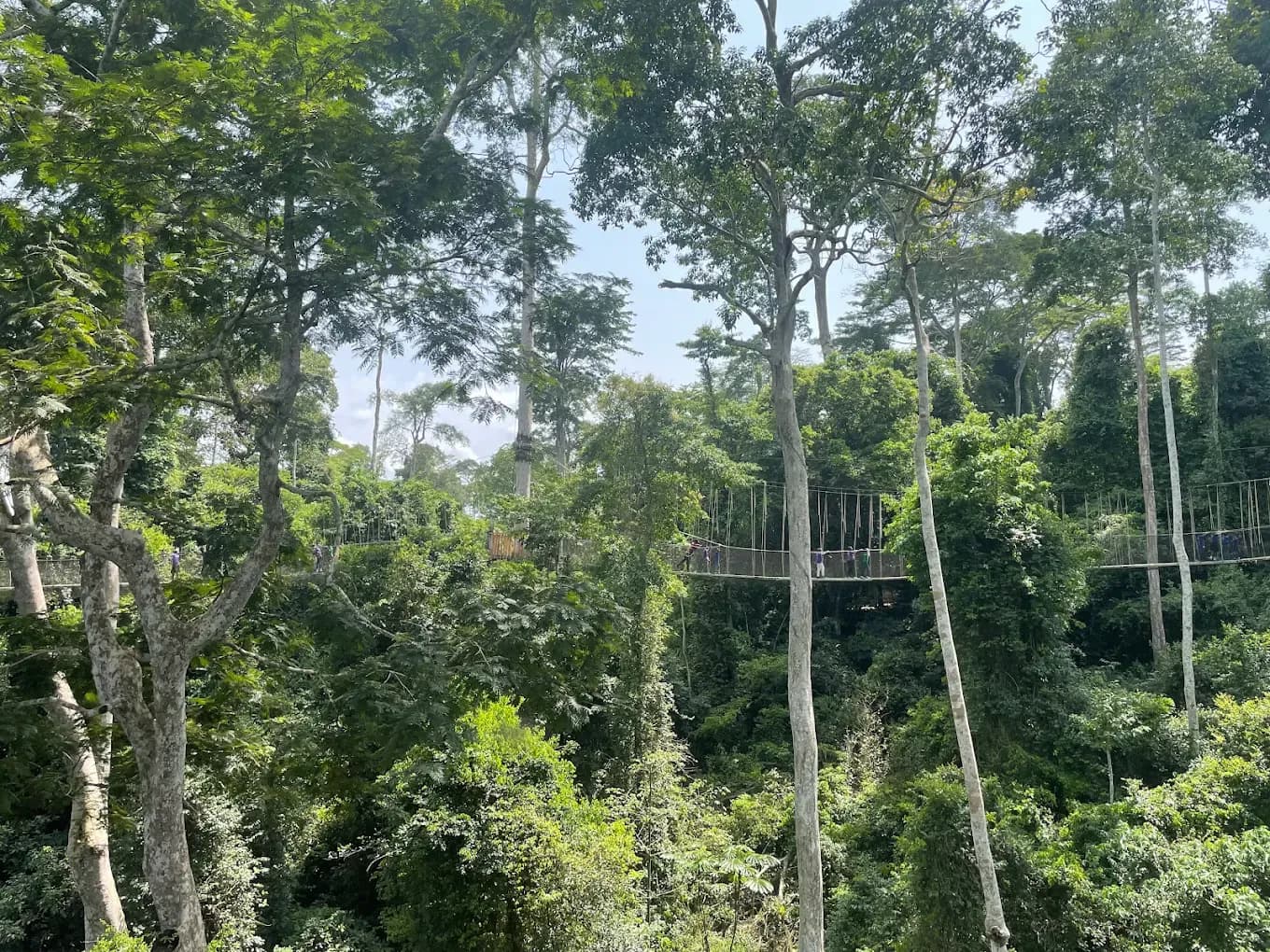
The canopy walkway suspended among tall rainforest trees at Kakum National Park

At a glance

Best time to go
Dry season, roughly November to March/April. The African Bird Club notes most southern forest birds breed in October-November and the north is good at the start of the rains (March-April); the main wet season (May-September) is best avoided.
Ideal trip length
14-16 days for the classic south forest plus Mole circuit (operators run 14-, 16-, 18- and 21-day versions). A south-only forest trip can be done in 7-10 days.
Species total (approx.)
About 750 recorded species nationally according to the African Bird Club. Other counts differ: eBird shows about 667 species (plus other taxa) and Wikipedia's list, based on Avibase, shows 772 confirmed species as of August 2021. Three-week small-group tours typically record roughly 410-460 species.
Getting there from The Gambia
No overland route. ASKY Airlines (KP) flight KP023 leaves Banjul early in the morning, but it is not non-stop: it runs Banjul - Freetown - Accra - Lomé, so Accra is the third stop on a one-stop routing via Freetown. Otherwise connect via a hub such as Dakar, Lagos, Casablanca or Istanbul. Schedules change, so confirm with ASKY or a travel agent (checked Oct 2026).
Visa / entry (US, UK, EU)
A visa is required. Ghana replaced visa-on-arrival with a mandatory online e-visa on 25 May 2026 (evisa.immigration.gov.gh). Single-entry fees reported at launch start at US$260 for standard processing; confirm on the official portal. A yellow fever certificate is required; passport valid at least 6 months (checked Oct 2026).
Currency
Ghanaian cedi (GHS). The exchange rate moves a lot, so check the current rate before you travel.
Language(s)
English is the official language, so communication is easy. Local languages such as Twi/Akan, Fante, Ga, Ewe and Dagbani are widely spoken in different regions.
Time zone
GMT all year, with no daylight saving. The same time as The Gambia.
Health headline
Yellow fever vaccination is required for entry (travellers aged 9 months and over). CDC recommends malaria prevention tablets, plus hepatitis A and B and typhoid vaccines and up-to-date MMR for most travellers. See a travel clinic at least a month ahead.
Electricity
230 V, 50 Hz. Sockets are mainly type G (UK-style three rectangular pins), with type D (three round pins) also found. Bring an adaptor.
Typical budget note
Ghana is not a cheap birding destination because of lodges, vehicle hire, internal flights and guide costs; Yaya can help you get a custom extension priced on request.

When to go

The dry season, roughly November to March/April, is the standard window for birding Ghana. Forest trails are easier, Palearctic migrants are present, and specialist tour operators mostly run in this window (recent departures in November, January-March and March-April). The African Bird Club recommends avoiding the main rainy period from May to September, and notes that the north is good at the start of the rains (March-April). Wildlife at Mole tends to gather at waterholes late in the dry season.

PeriodConditionsBirding
November to February (dry season; Harmattan from about December)Mostly dry across the country. The Harmattan, a dry desert wind, blows from about December to March, bringing dry air, hotter days and cooler nights, most noticeably in the north-east.Good all-round birding in the southern forests; Palearctic migrants and waders are present on the coast (Muni-Pomadze, Sakumo, Densu). The African Bird Club notes that southern forest birds breed around October-November, so they are vocal. Harmattan haze can reduce photography and long-range visibility in the north.
March to April (late dry season, start of the rains)Hot and humid in the south and hotter in the north, with the first rains arriving from about April.Very good. The African Bird Club recommends the start of the rains for the north. Standard-winged Nightjar and Egyptian Plover were seen on recent tours in February-March (recent tours, 2023-2024).
May to July (rains in the south)The south has a bi-modal rainy pattern, with the first wet period around April to June. The African Bird Club recommends avoiding the main wet season (May-September) because trails and forest tracks become muddy and driving is slow.Possible but hard work. Access to forest tracks is slower and birds are harder to find; a good option only for birders who specifically want a low-season trip.
August to October (north at peak rains; south has a break, then second rains)The north has a single rainy season from about April to mid-October, peaking in August-September. In the south, a second wet period runs from about September to November. Exact timings vary year to year.Autumn migrants begin to arrive from about September-October. Many southern forest birds start breeding around October-November. The north is green but wet, and access can be slow.

Target birds and where to find them

SpeciesWhereNotes
White-necked RockfowlBonkro (Nyamebe Bepo Forest), Central RegionAlso sold as Yellow-headed Picathartes; 'White-necked Rockfowl' is the usual current name for Picathartes gymnocephalus. IUCN Vulnerable. It was rediscovered in Ghana in 2003. Nine were seen at a new site near Bonkro in March-April 2024, and it was the top bird of a 2023 tour. Viewing is in the late afternoon, with a local guide, before the birds settle at dusk.
Nkulengu RailAnkasa; also reported from KalakpaA very hard-to-see forest rail. A family group of five was seen at Ankasa in 2024, and it ranked among the top birds of a 2023 tour. It is usually located by its calls, so expect night and early-morning work.
Akun Eagle-OwlAnkasaA pair was seen and heard near Ankasa Lodge on a 2024 tour. Torch and a local guide with the calls are essential.
Fraser's Eagle-OwlAnkasa (Roloway Monkey Trail area)Seen in forest near the Roloway Monkey Trail at Ankasa in 2024. Torch and a local guide with the calls are essential.
White-breasted GuineafowlAnkasa Conservation AreaA threatened Upper Guinea forest guineafowl, and the reason Ankasa is an Important Bird Area. Operators describe it as very rare, and it was not recorded on the 2023 or 2024 tours checked. Wikipedia's Kakum page also lists it for Kakum, but operators target it at Ankasa.
Black Bee-eaterAnkasa, Abrafo and AtewaA pair nested at Ankasa Lodge on a 2024 tour, and it was also seen at Abrafo and Atewa. Often perched on bare twigs along forest tracks.
Blue-moustached Bee-eaterAtewa Range; also seen at Ankasa in 2023Scarce. It is targeted on the Atewa ridge, and four were seen in Ankasa forest on a 2023 tour (described as a lucky observation).
Rosy Bee-eaterKakum farmbush and walkway, Antwikwaa, Abrafo and Nsuta; also reported at KalakpaSeen at Kakum, Antwikwaa, Abrafo and Nsuta on a 2024 tour, and one of the ten bee-eater species counted on a 2023 tour. Seasonal.
Red-throated Bee-eaterMole National ParkAppears on Mole's trails. Already familiar to Gambia birders from the Gambia River.
Brown-cheeked HornbillKakum National ParkA threatened Upper Guinea species. Five were counted at Kakum in 2024.
Black-casqued HornbillKakum National Park and AntwikwaaA flock of 23 was counted at Kakum and 12 at Antwikwaa on a 2024 tour. Large, noisy and conspicuous in fruiting trees.
White-crested HornbillSouthern forestReported by tours at several southern forest sites; ask your guide for current spots.
Piping HornbillSouthern forestReported by tours across southern forest sites; hornbill diversity is one of the highlights of the south.
Western Dwarf HornbillNsuta, Ankasa and KwabenasamCalled Black Dwarf Hornbill in older lists. It was recorded at Nsuta and Ankasa on a 2024 tour. A small and often hard-to-find forest hornbill.
Great Blue TuracoAnkasaListed for Ankasa days by operators, but it was only heard on a 2024 tour. A huge turaco of wet forest.
Yellow-billed TuracoSouthern forest, including AnkasaSeen nicely at Ankasa on a 2024 tour. Look for it in fruiting canopy trees.
Violet TuracoMole National Park; Shai HillsA savanna turaco, seen well at Mole and listed by the Wildlife Division for Shai Hills. Also found in The Gambia.
Bristle-nosed BarbetNsuta and Antwikwaa; also on Kakum's checklistSeen at Nsuta and Antwikwaa in 2024. Kakum is also a good forest-barbet site, with Hairy-breasted and Naked-faced Barbets and Red-rumped Tinkerbird.
Yellow-bearded GreenbulAnkasaThree were unusually obliging at Ankasa ponds on a 2024 tour, and it is a regular Ankasa target on specialist tours. Greenbuls are best learned by call.
Green-tailed BristlebillAnkasa and southern forestListed as a forest target at Ankasa by specialist tours and by the African Bird Club as an Upper Guinea endemic.
Rufous-sided BroadbillAnkasa; Atewa RangeOne was seen displaying at Ankasa in 2024, and it is among the Atewa ridge targets. Atewa is a hard day.
Red-cheeked Wattle-eyeStingless Bee Road (Jukwa, Kakum area)A pair gave amazing looks in 2024 along Stingless Bee Road, and it ranked second among the top birds of a 2023 tour.
Long-tailed HawkBobiri Forest Reserve; Atewa, Nyamebe and Kakum on operator itinerariesOne adult was seen at Bobiri on a 2024 tour after the species was only heard at Ankasa. It is also listed for Atewa, Nyamebe and Kakum.
Congo Serpent EagleKakum canopy walkway; Nyamebe Forest; KalakpaSeen from the Kakum canopy walkway in 2024. It is also listed for Nyamebe and Kakum, and the Kalakpa status report lists it for that reserve.
Egyptian PloverWhite Volta River, a side trip west of Mole National ParkSeen on a White Volta excursion from Mole on recent tours, with a small breeding population reported. Also a Gambia bird, but more difficult there.
Standard-winged NightjarMole National Park (the airstrip)Males display with long pennants in the breeding season. It was seen on tours in 2023 and 2024. Timing matters, as the pennants are seasonal.
Forbes's PloverMole National ParkListed by operators among Mole's savanna specialties. It was ranked third among the top birds of a 2023 tour, and two roosting birds were found in 2024 after a first-afternoon miss. Seasonal and elusive.
Abyssinian Ground HornbillMole National ParkWalks in the savanna, often in small groups. Also found in The Gambia.
Martial EagleMole National ParkMartial Eagle is among the species for which Mole was designated an Important Bird Area. Also found in The Gambia.

Key birding sites

The Kakum canopy walkway seen from across the forest

Central Region, about 33 km north of Cape Coast

Kakum National Park

Kakum protects about 375 square kilometres of Upper Guinea rainforest and has been a national park since 1992. It is an Important Bird Area with 266 confirmed bird species and nine hornbill species. The canopy walkway, seven bridges roughly 40 metres above the ground and 330 metres long according to Wikipedia, gives birders eye-level access to canopy birds that are otherwise very hard to see. Most birders also use the Abrafo forest trail and the Antwikwaa area near Twifo Praso, where 12 Black-casqued Hornbills and other forest species were logged in 2024, and the Stingless Bee Road at Jukwa. Twenty-three Black-casqued Hornbills were counted at Kakum itself in 2024. Early start and a local guide are essential.

Lowland moist evergreen rainforestCanopy walkwayForest edge and farmbushStreams
Best time
November to March; arrive for dawn for the canopy walkway.
Suggested time
2-3 nights
Getting there
About 33 km north of Cape Coast. Allow most of a day when travelling from Accra (typically several hours by road; traffic is the main variable). Ask your driver or operator for a current estimate.

Where to stay

  • Rainforest Lodge (Jukwa, on the road towards Kakum): a base used repeatedly by birding tours, with about 15 rooms and a breakfast that is included. Confirm availability with the lodge.

Birds to look for

Brown-cheeked HornbillBlack-casqued HornbillHairy-breasted BarbetNaked-faced BarbetRed-rumped TinkerbirdCongo Serpent EagleRosy Bee-eaterLong-tailed Hawk
An African Emerald Cuckoo in the forest at Ankasa

Western Region, near the Côte d'Ivoire border

Ankasa Conservation Area

Ankasa is a roughly 509-square-kilometre area combining Nini-Suhien National Park and the Ankasa Resource Reserve, and it is the only protected area in Ghana in the wet evergreen rainforest belt. It is an Important Bird Area, designated because of rare species such as White-breasted Guineafowl. Birders go for forest species that are hard elsewhere in the country, including Nkulengu Rail, Akun and Fraser's Eagle-Owls and Black Bee-eater (all recorded on a 2024 tour), as well as Great Blue Turaco and Yellow-bearded Greenbul. It is a remote, humid, birding-by-trail site, so expect long walks in the early morning and night walks for owls and rails. Accommodation is at the park gate, which is why many operators build in two nights.

Wet evergreen rainforestForest streams and swamp forestForest tracks
Best time
November to March; Ankasa is in the wettest forest belt in Ghana, so rain showers are possible at any time.
Suggested time
2 nights
Getting there
Park entrance at Sowodadzem, about 120 km from Takoradi and 22 km from Elubo along the Takoradi-Elubo highway, according to the Ghana Wildlife Division. Allow most of a day by road from Accra. Tracks inside the park are rougher than the highway.

Where to stay

  • Ankasa Reserve Lodge (at the park entrance gate, on the Ankasa River): riverfront chalets, garden-view rooms and camping, with air conditioning in the rooms and chalets according to its website; it opened in January 2022. A pair of Black Bee-eaters nested there in 2024.
  • Ghana Wildlife Division chalets inside the park: four two-bed chalets with basic cooking facilities and solar power, and group stays at the Ankasa Exploration Base.
  • Beach resorts 1-2 hours' drive away are alternatives, according to the Wildlife Division.

Birds to look for

White-breasted GuineafowlNkulengu RailAkun Eagle-OwlFraser's Eagle-OwlGreat Blue TuracoBlack Bee-eaterYellow-bearded Greenbul

Central Region, near Assin Foso

Bonkro and Nyamebe Bepo Forest

Bonkro is a village beside the Nyamebe Bepo forest, where White-necked Rockfowl nest on rock faces and boulders. Birding Site Guide calls it the best tourist site for the species. It is a well-known example of community-based conservation tourism: visits are led by village guides, and proceeds from the guesthouse, restaurant and forest entrance fees go to a community fund. From the village it is a walk of roughly 30-40 minutes through farmland and forest on a mostly level trail, arriving before dusk so you can sit quietly and wait for the birds to return to roost. Nine were seen at a new site near Bonkro in 2024. The Picathartes Guest House was built in 2021 so that visitors can stay overnight rather than make a short visit.

Upper Guinea forest on rocky hillsCave and boulder nest sitesVillage and farmbush
Best time
Year-round for the rockfowl according to the Birding Site Guide; operators visit in the dry season for easier travel.
Suggested time
1 night
Getting there
Near Assin Foso in the Central Region (about 5.7 degrees north, 1.3 degrees west). Plan Bonkro as an overnight stop between Kakum and the Kumasi direction; ask your operator for current drive times. The final stretch is rural and the site is reached on foot with a guide.

Where to stay

  • Picathartes Guest House in Bonkro (community-run): five simple en-suite bungalow rooms with fans, per Rainbow Tours; proceeds go to the community fund.
  • Hotels in Kumasi are the fallback.

Birds to look for

White-necked RockfowlSpeckled TinkerbirdYellow-rumped TinkerbirdGreen-headed Sunbird
A Red-throated Bee-eater perched on a bare branch in Mole National Park

Savannah Region, northern Ghana

Mole National Park

Ghana's largest protected area, covering roughly 4,577 square kilometres of Guinea savanna woodland. It is an Important Bird Area with 344 recorded bird species and about 800 elephants. The birding is Sudanian, so many species will be familiar from The Gambia (Abyssinian Ground Hornbill, Violet Turaco, Martial Eagle, Abyssinian Roller, Red-throated Bee-eater), with specials that are harder in The Gambia such as Standard-winged Nightjar in season and Forbes's Plover. Egyptian Plover is seen on a side trip to the White Volta River west of the park. Visits are by vehicle and guided walking safari, and the escarpment and waterholes are the highlights.

Guinea savanna woodlandWaterholes and riverEscarpmentAirstrip and open ground
Best time
The dry season, roughly November to April; tours have recorded Standard-winged Nightjar and Egyptian Plover in February-March.
Suggested time
3 nights
Getting there
Mole is around 700 km from Accra by road, so most visitors fly Accra-Tamale (Africa World Airlines and PassionAir both list the route) and then drive to the park via Larabanga. Allow roughly three hours by road from Tamale and ask your lodge to confirm. Fill the tank in Tamale and expect slower going in the rains.

Where to stay

  • Zaina Lodge (inside the park): 25 luxury tented chalets with air conditioning, billed as West Africa's first luxury safari lodge.
  • Mole Motel (inside the park, government-run): about 33 en-suite rooms including chalets, family rooms and dormitories, and the more budget-friendly option.

Greater Accra Region, off the Tema-Akosombo road

Shai Hills Resource Reserve

A small reserve of dry coastal savanna and rocky hills, about 51 square kilometres and the wildlife park closest to Accra. It is popular with birders on the first or last day of a trip. The Wildlife Division lists Stone Partridge, Senegal Parrot, Violet Turaco and Western Plantain-eater among its birds. It is a convenient first morning and a good chance to get used to local birds before the forest sites.

Dry coastal savannaRocky hills and cavesOpen woodland and thickets
Best time
November to April, for easier conditions.
Suggested time
Half day
Getting there
About 50 km from Accra according to the Wildlife Division, off the Tema-Akosombo road. Allow a morning from Accra; traffic is the main variable.

Where to stay

  • Most birders stay in Accra or Tema and visit as a day trip.

Birds to look for

Stone PartridgeViolet TuracoSenegal ParrotWestern Plantain-eater

Central Region, around 55 km west of Accra

Muni-Pomadze Ramsar Site (Winneba Plains)

A coastal lagoon and floodplain Ramsar site near Winneba, designated in 1992 for its internationally important tern populations and its total waterbird numbers. The site covers about 9,500 hectares including the Muni Lagoon, the surrounding floodplain and the beach, and 48 waterbird species have been recorded there, including 29 waders, eight terns and seven herons and egrets. It is a handy stop on the road between Accra and Kakum, best in the dry season when migrant waders and terns are present.

Saline coastal lagoonFloodplainBeachOpen coastal grassland
Best time
October to April, when Palearctic waders and terns are present.
Suggested time
2-3 hours, on the way to Kakum
Getting there
About 55 km west of Accra on the coastal road to Cape Coast and Kakum. Allow roughly 1-1.5 hours from Accra depending on traffic (estimate).

Where to stay

  • Most birders do not stay here; it is a stop between Accra and Kakum.

Birds to look for

Curlew SandpiperCommon Ringed PloverCommon GreenshankBlack-winged StiltRoyal TernSandwich TernCommon TernBlack Tern

Greater Accra Region

Sakumo and Densu Delta Ramsar Sites (Accra wetlands)

Two coastal wetlands on either side of Accra. Sakumo (Sakumono) Ramsar Site covers about 1,400 hectares between Accra and Tema, with egrets, terns, plovers and herons, and Densu Delta lies roughly 11 km west of Accra with an open lagoon, salt pans, freshwater marsh and dunes. Densu has recorded about 60 waterbird species and up to roughly 35,000 birds, and is important for roosting terns, including Roseate Tern. They give a good first or last half day in the dry season. Both sites are under development pressure, so conditions vary and a local guide helps.

Coastal lagoonSalt pansFreshwater marshDunes and scrub
Best time
November to April, for migrant waders and terns.
Suggested time
Half day
Getting there
Sakumo is on the coast about 3 km west of Tema; Densu Delta is about 11 km west of Accra. Both are a short drive from the city.

Where to stay

  • Stay in Accra; both are easy half-day outings.

Birds to look for

Roseate Tern

Eastern Region, near Kibi

Atewa Range Forest Reserve

An upland evergreen forest on a ridge near Kibi, gazetted as a forest reserve in 1926 and covering roughly 26,000 hectares (Wikipedia gives 17,400 hectares; area figures differ between sources). It is an Important Bird Area and a Key Biodiversity Area, and the headwaters of the Ayensu, Densu and Birim rivers, supplying water to millions of Ghanaians. Birds reported by tours include Blue-moustached Bee-eater, Rufous-sided Broadbill, Long-tailed Hawk and Nimba Flycatcher. Atewa is the most physically demanding site on the main circuit: the ridge climb is reported at about 6 km each way (12 km round trip). It has been threatened by bauxite mining plans for years. Ghana repealed the law allowing mining in forest reserves in December 2025, and a formal process to make Atewa a national park is reported, but it is still a forest reserve. A Rocha Ghana reported in September 2026 that illegal mining there is escalating. Conditions and access are evolving, so check with your operator before planning.

Upland evergreen forestRidge and summit forestFarmbush at the foot of the hills
Best time
November to March; the dry season is easier for the climb.
Suggested time
1 night or a long day trip
Getting there
Bunso is the usual starting point on tours; allow roughly 2 hours from Accra (estimate). The climb to the ridge is steep and best done with a local guide.

Where to stay

  • Specialist itineraries use hotels in Bunso, between Accra and Atewa. Confirm lodging options before booking.

Birds to look for

Blue-moustached Bee-eaterRufous-sided BroadbillLong-tailed HawkNimba Flycatcher

Ashanti Region, near Kubease

Bobiri Forest Reserve and Butterfly Sanctuary

A small semi-deciduous forest reserve of about 55 square kilometres beside the Accra-Kumasi highway, established in 1939, with more than 200 recorded bird species and a butterfly sanctuary (sources give figures from about 400 to over 900 butterfly species). It is a favoured stop between Kumasi and Accra because Long-tailed Hawk was seen here on a 2024 tour. The forest is walked on wide tracks, so it is comfortable birding compared with other forest sites.

Semi-deciduous forestForest tracksButterfly sanctuary and clearings
Best time
November to March.
Suggested time
Half day to 1 night
Getting there
On the main Accra-Kumasi highway at Kubease, about 30 km from Kumasi.

Where to stay

  • Bobiri's own lodging is limited; most visitors base in Kumasi.

Birds to look for

Long-tailed Hawk

Ashanti Region

Nsuta Forest Reserve

A forest reserve in the Ashanti Region that a 2024 tour visited on the way into the south-west, recording Western Dwarf Hornbill, Bristle-nosed Barbet and Rosy Bee-eater there. It is a modest day stop rather than a base.

Semi-deciduous forestForest tracks
Best time
November to March.
Suggested time
Half day
Getting there
Within day reach of Kumasi; arrange a local guide.

Where to stay

  • Base in Kumasi.

Birds to look for

Western Dwarf HornbillBristle-nosed BarbetRosy Bee-eater

Volta Region, about 120 km north-east of Accra

Kalakpa Resource Reserve

A forest-savanna reserve of about 32,000 hectares at the foot of the Togo Mountains, designated an Important Bird Area. A limited four-day survey recorded 148 species, with the total estimated at about 200, including Congo Serpent Eagle, Nkulengu Rail and Rosy Bee-eater. Specialist operators include it on their longer routes. It is off the main circuit, so it fits the 16-21 day tours.

Forest-savanna mosaicGallery forest
Best time
November to March.
Suggested time
1 night
Getting there
Roughly 30 km south of Ho in the Volta Region; arrange transfers with an operator.

Where to stay

  • Check with an operator; lodging near the reserve was not verified for this guide.

Birds to look for

Congo Serpent EagleNkulengu RailRosy Bee-eater

Getting there and getting around

Fly into Kotoka International Airport (ACC) in Accra. From The Gambia there is no practical overland route, and the only flight from Banjul to Accra makes a stop, so allow time to check schedules. Ghana is on GMT, the same time zone as The Gambia, so there is no jet lag.

From The Gambia

  • ASKY Airlines (KP) flight KP023 is the only Banjul-Accra flight found. It is not non-stop: schedule trackers list it as Banjul (BJL) - Freetown (FNA) - Accra (ACC) - Lomé (LFW), leaving Banjul at about 06:00 and calling at Freetown and Accra for roughly 35-55 minutes each before reaching Lomé. Trip.com's flight-status page shows it operating on 1 October 2026, and its schedule listings show daily service. AeroRoutes describes ASKY's pattern as Lomé - Accra - Freetown - Banjul. Trip.com's separate Banjul-Accra page also quotes a block time of about 4 hours 20 minutes, which fits a one-stop flight via Freetown. ASKY's own website could not be opened to confirm, so check days and times with ASKY or a travel agent before booking (checked Oct 2026).
  • Other options are connections via regional hubs. Wikipedia's Banjul airport page lists Air Peace and ValueJet flying to Lagos, Air Peace, Air Senegal and Transair to Dakar, Royal Air Maroc to Casablanca and Turkish Airlines to Istanbul, with onward connections to Accra on other carriers (Wikipedia's Accra page lists Royal Air Maroc, Turkish and others). Journey times with a connection are typically longer than the ASKY schedule.
  • Always check baggage allowances and visa requirements for any transit country.

From abroad

  • Kotoka (ACC) lists non-stop links to London (British Airways to Gatwick and Heathrow), Amsterdam (KLM), Brussels, Rome (ITA), Lisbon (TAP), Istanbul (Turkish), Casablanca (Royal Air Maroc), New York JFK (Delta), Washington Dulles (United), Dubai (Emirates) and Addis Ababa (Ethiopian), per Wikipedia's airport page (checked Oct 2026).
  • Domestic flights: Africa World Airlines and PassionAir are both listed on the Accra-Tamale route, which is the usual way to reach Mole National Park. Check current schedules and fares with the airlines.
  • Most birding trips start and end in Accra, so book an open-jaw flight or allow a final night in Accra before the flight home.

Getting around

  • Ghana's birding circuit is a long chain of sites. Rough drive times from Accra are only approximate and traffic out of Accra is the main variable: Cape Coast and Kakum are roughly a half-day away, Ankasa and Kumasi each take most of a day by road, and Mole is about 700 km by road (so most visitors fly to Tamale). Ask your operator or driver for current estimates.
  • Most visitors use a private vehicle with a driver, arranged by a tour operator or a local company. Self-drive is possible, but road conditions, police checkpoints and the difficulty of finding some sites make a driver far more practical. Daylight driving is easier because street lighting is poor and animals and pedestrians are often on the road, so plan to reach your lodge before dark.
  • Roads between the main towns are generally paved, though the Accra-Kumasi road can be congested and slow. Tracks into the forest reserves, particularly in the rains, can be rough, and a 4x4 or high-clearance vehicle is useful for some sites.
  • To reach Mole, fly Accra-Tamale (Africa World Airlines and PassionAir both list the route), then drive to the park via Larabanga. This saves a very long road journey each way compared with driving from Accra.
  • Hire a local site guide at every forest site. Calls are the key to finding forest birds, and sites such as Bonkro operate through their own village guides. Ask your operator what fees are charged.
  • Mobile data and WhatsApp are widely used for booking guides and lodges, but reception inside forest reserves is patchy.

Practical information

Entry rules, health advice and prices change. Check the official sources below, or ask Yaya, before you book.

Visas and entry

  • Visa required for US, UK, EU, Canadian and Australian passport holders (checked Oct 2026). Ghana launched its mandatory online e-visa on 25 May 2026 at evisa.immigration.gov.gh and the previous visa-on-arrival system has been discontinued. Apply before you fly: Fragomen warns that failure to follow the new rules may result in denial of boarding or refusal of entry.
  • Fees reported by VisasNews and travel-news sites at launch: single entry US$260 (standard), US$338 (priority), US$442 (express); multiple entry US$468, US$608 and US$796. Wikipedia's visa-policy page gives the same standard fees. We could not open the official fee table, and one page on the official portal showed different figures, so check the fee and processing time on the portal before paying. The portal lists standard processing as 96 hours; some reports say 72 hours.
  • The official portal says the visa can be used within 90 days of issue, and the length of stay is set by the immigration officer at the border (up to 60 days). Check your approval email for the permitted stay.
  • Passport validity: UK government advice says the passport should be valid at least six months after arrival; the e-visa portal gives six months as the recommended minimum.
  • A yellow fever vaccination certificate is required for entry (UK government and CDC). Carry the original certificate.
  • African Union and some Caribbean nationals can apply for a free Electronic Travel Authorization, and ECOWAS citizens are visa-free (Gambian passport holders are ECOWAS citizens). These rules do not apply to Europeans or North Americans. Check with the authorities, as the rules are new.

Health

  • Yellow fever vaccination is required for all arriving travellers aged 9 months and over, and CDC also recommends it for that group.
  • CDC recommends malaria prevention tablets for travellers to Ghana (atovaquone-proguanil, doxycycline, mefloquine or tafenoquine; chloroquine resistance is present). Speak to a travel clinic about which is right for you.
  • CDC also recommends hepatitis A and B, typhoid and up-to-date MMR for most travellers, and rabies for some. Other risks include dengue and schistosomiasis (avoid swimming or wading in fresh water). Many diseases cannot be prevented with a vaccine, so use repellent and cover skin in forest.
  • Healthcare is limited outside Accra, Kumasi and a few other large cities. Travel insurance with medical evacuation is strongly advised, particularly for Ankasa and Mole.
  • Drink bottled or filtered water. See a travel clinic at least one month before departure.

Costs

  • Currency is the Ghanaian cedi (GHS). The exchange rate has moved a lot in recent years, so check the current rate before you go. Cards are accepted in Accra hotels but carry cash in smaller towns and parks.
  • Park entry, guide and vehicle fees change often and published figures are inconsistent between sites, so none are quoted here. Confirm current fees with the Ghana Wildlife Division, the park office or your operator, and always carry cash for the gate.
  • Guides: local birding guides at Bonkro, Kakum, Ankasa and Mole are normally arranged through a tour operator or the site office. Expect separate fees for the guide, the community and entrance; ask for a quote.
  • Lodges: in Mole, Zaina Lodge is the upmarket option and Mole Motel the budget one. Elsewhere, mid-range lodges and guesthouses are the norm, and Bonkro and Ankasa are fairly simple. Prices were not verified for this guide.
  • Internal transport: Accra-Tamale flights are listed with Africa World Airlines and PassionAir; fares vary. A private car and driver for several weeks is the main cost for a self-organised trip. Ask for a written quote including fuel and the driver's accommodation.
  • Ghana is not a cheap birding destination because of lodges, vehicle hire, internal flights and guide costs. Yaya can help you get a custom extension priced on request.

What to pack

  • Lightweight, quick-drying long-sleeved shirts and trousers in muted colours; the forest is hot, humid and buggy.
  • Rain jacket or poncho and a waterproof bag or dry bag for binoculars and camera, even in the dry season in the south.
  • Insect repellent (DEET-based, as CDC advises), a treated mosquito net if your accommodation does not provide one, and malaria tablets.
  • Tick and insect precautions for forest trails: long trousers tucked into socks or gaiters.
  • A strong head torch plus a spare for Ankasa and Bonkro; owls, nightjars and rails are active at dusk and at night. A powerful spotlight is useful for owling.
  • Comfortable waterproof walking boots or trail shoes with grip. Forest trails can be wet and steep, and Atewa is a long climb (about 12 km round trip).
  • Binoculars (8x or 10x) and a camera with a long lens if you can carry it; canopy walkway birds are high. Guides use playback, so a phone with a call app can help, but use it sparingly.
  • Field Guide to the Birds of Ghana by Nik Borrow and Ron Demey (Helm, second edition 2022) is the standard field guide. Bring a notebook for checklists.
  • A UK-style (type G) plug adaptor, with type D as a backup, plus a power bank and a copy of your yellow fever certificate and e-visa.

Tips

  • White-necked Rockfowl: view only through the community guides, sit quietly where the guide puts you, avoid flash photography and playback, and leave the birds in peace as soon as the guide says it is time to go. Visits are led by village guides, and income from the guesthouse, restaurant and entrance fees goes to the community fund.
  • Do not go to rockfowl colonies independently or pay unofficial guides; fees go to the community.
  • Be careful with call playback. Many sites are heavily visited and guides will use it sparingly; follow the guide's lead, especially for nesting, endangered or roosting birds. Do not use playback at the Picathartes site.
  • Hire local guides at every forest site. It supports conservation and local livelihoods, and the guides' knowledge of calls is essential.
  • Greet people politely and ask permission before photographing people or in villages; use your right hand for greetings and handing things over.
  • Dress modestly in villages and towns and tip guides and drivers for good service; check with your operator for customary amounts.
  • Start early. Forest birding is best from dawn to mid-morning, so arrange early breakfasts with your lodge.

Sample routes

7 days

7-day south forest highlights

Accra - Winneba - Kakum/Abrafo/Antwikwaa - Bonkro - Accra

A compact trip built around Kakum's canopy walkway, the Antwikwaa and Abrafo forest trails and the White-necked Rockfowl at Bonkro. Add a morning at Shai Hills or Sakumono on arrival and a coastal stop at Muni-Pomadze. It leaves out Ankasa and Mole, so expect fewer rails, owls and savanna species. This is an indicative outline based on operator routes, not a tested schedule.

10 days

10-day forest circuit with Ankasa

Accra - Muni-Pomadze - Kakum/Antwikwaa - Ankasa (2 nights) - Bonkro - Bobiri/Nsuta - Accra

Adds Ankasa (for Nkulengu Rail, Akun and Fraser's Eagle-Owls, Black Bee-eater and a chance at White-breasted Guineafowl) to the Kakum and Bonkro core, then returns through Bobiri for Long-tailed Hawk and Nsuta for forest birds. The long drives between Ankasa, Bonkro and Kumasi take a large part of two days. Indicative routing based on operator itineraries.

15 days

14-16 day south and Mole

Accra - Kakum - Ankasa - Bonkro - Bobiri - Mole (fly Accra-Tamale or drive) - back to Accra

A classic 14-16 day circuit: Accra wetlands and Shai Hills, the southern forest sites, Bonkro for the rockfowl, then Mole for three nights for savanna birds including Standard-winged Nightjar and Forbes's Plover, with a side trip to the White Volta for Egyptian Plover. Atewa and Kalakpa can be added to extend. The Mole leg can be done by flight from Accra to Tamale to save a long road journey. Indicative outline only.

21 days

Comprehensive 18-21 day tour

Accra - Atewa - Bobiri - Mole - Bonkro - Kakum - Ankasa - Kalakpa - Accra

A comprehensive 18-21 day circuit: Kakum, Ankasa, Bonkro, Mole, Atewa and Kalakpa. This gives the best chance at the hardest species (such as Blue-moustached Bee-eater, Rufous-sided Broadbill, Nkulengu Rail and Congo Serpent Eagle). The sequence varies between operators. Yaya can help think through a custom Ghana extension, including how it fits around a Gambia trip.

Combining Ghana with The Gambia

Ghana works best as a stand-alone extension rather than a short add-on to a Gambia trip. It means a flight out of Banjul, and there is no practical overland route. The only Banjul-Accra flight found is ASKY Airlines KP023, which departs early in the morning and calls at Freetown on the way to Accra, and the same time zone means no jet lag; check the exact schedule and days with ASKY before booking. Many birders instead do The Gambia first for its easy birding and river trips, then fly out via a hub, or arrange separate tickets. A sensible pairing is 7-10 days in The Gambia and 10-14 days in Ghana, ending the trip with Ghana's rainforest species. The birds overlap in the savanna, with Mole offering much of what you can see in The Gambia, so many visitors prioritise the forest sites. Yaya is based in The Gambia and can help you plan the Gambia side and talk through a Ghana extension, but Ghana would be arranged with a Ghanaian operator or driver-guide.

Common questions

Sources and further reading

Extend your trip into Ghana

Tell Yaya you're interested in a cross-border extension and he'll help plan the logistics.