Birds for beginners
10 Easy Birds to See in The Gambia (Even If You've Never Birded Before)
Ten bold, colourful and common birds, with a plain-English tip for spotting each one on your first morning.
Published by Gambia Birding Team · · 6 min read
You do not need to be an expert to enjoy the birds of The Gambia. One local guide says that even for an amateur, Gambian birds are fairly easy to spot, because they are conspicuously coloured and vocal.[1] The trick on a first trip is knowing which few to look for, rather than trying to learn all of them.
This list is that shortcut. Each of these ten is widespread, distinctive and either bold or loud, and each has one thing you can look for. We only called a bird “easy” where a source describes it as common, so a couple of our first choices were swapped out along the way. All ten are residents, so you can see them at any time of year.
Key takeaways
- Pied Kingfisher, Little Bee-eater and Long-tailed Glossy Starling are described as common or even abundant across their ranges, so they make a gentle start.[2][3][4]
- Look near water for the Pied Kingfisher and African Fish Eagle, in gardens and scrub for the bee-eater, cordon-bleu and starlings, and in woodland for the owlet and turaco.[2][7][5][9]
- Some birds are easier to hear than see. The Yellow-crowned Gonolek and Pearl-spotted Owlet are usually found by their calls first.[9][11]
- A local guide will speed things up, but you can start on your own at a hotel garden or a stream such as Kotu Stream, which one guidebook calls a great introduction to birdwatching in The Gambia.[12]
How we picked these ten
Three rules. The bird has to be common in The Gambia, it has to be unmistakable once you know the clue, and we need to have a photograph of it by Yaya Barry. That is why the list leans towards bright, bold species rather than the tricky brown ones that experienced birders love.
Each entry has a short “how to spot it” tip. Where a bird is a little harder than the rest, we say so. You can find every species in more detail on the Gambia birds guide, and if you want to keep a tally, the full bird list is there too.
Along the river and creeks
1. Pied Kingfisher
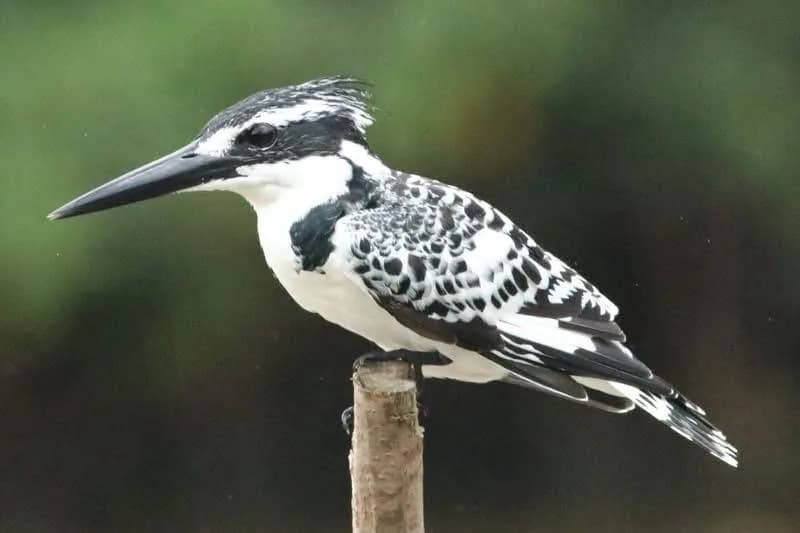
Look for a black-and-white bird hovering above open water, then plunging in headfirst. It is one of the three most numerous kingfishers in the world,[2] and along the river it is a regular sight, diving with its wings tucked back.[1] Males have a double black breast band, and females a single, often broken one.[2] Here is the full Pied Kingfisher page.
2. African Fish Eagle
Listen for the call before you look for the bird. Its ringing cry is, for many people, the sound of Africa,[7] and the adult is hard to miss: white head, breast and tail, with a chestnut body and a yellow face.[7] It stays near open water with a good perch, so creeks, rivers and lagoons are the place to scan.[7] See the African Fish Eagle page.
3. Palm-nut Vulture
This is the odd one out: a vulture that mainly eats palm fruit. Adults are almost entirely white with black wings and tail, and a red patch around each eye.[8] The species is fairly common with a stable population, and is most common in coastal forests and mangroves, so look wherever there are oil palms.[8] Its page is here: Palm-nut Vulture. Of our ten, it is the one we would rate a little less certain on a short trip.
In gardens, scrub and open country
4. Little Bee-eater
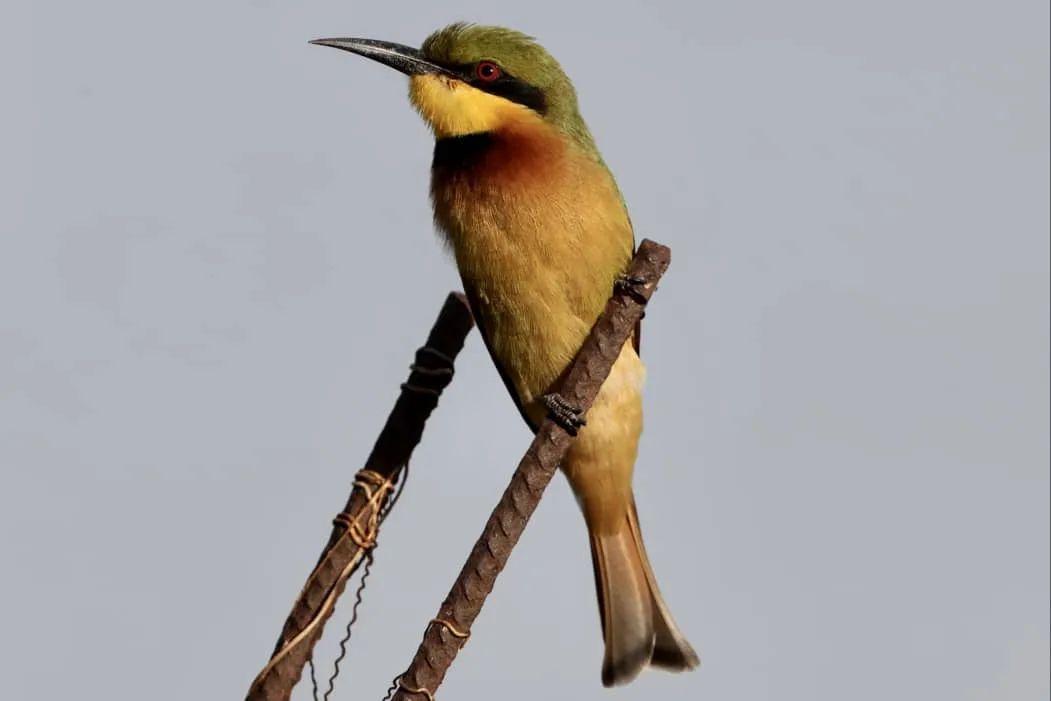
The smallest African bee-eater, at only 15 to 17 cm, with a yellow throat and a black collar.[3] Wikipedia calls these abundant and tame birds,[3] and they often hunt from low perches, perhaps only a metre high.[3] Scan fences, low bushes and reeds, then watch for a short dash after an insect. More on the Little Bee-eater.
5. Red-cheeked Cordon-bleu
A tiny sky-blue finch, only 12.5 to 13 cm long, and the male wears a red patch on each cheek.[5] It is frequently seen at open dry grassland and around human habitation.[5] One Gambian lodge calls it a wonderfully easy spot for first-time watchers, and says it visits daily.[6] Look for it on the ground around paths and lawns. See the Red-cheeked Cordon-bleu.
6. Long-tailed Glossy Starling
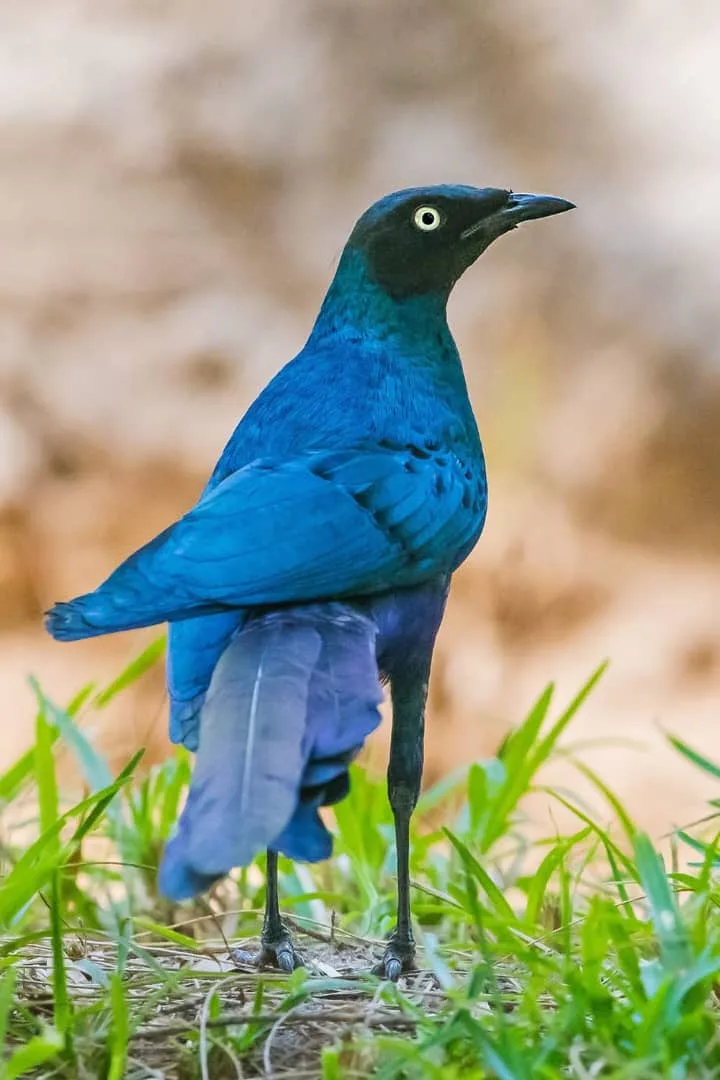
A big starling with a long, purple tail and a yellow eye, about 54 cm in all.[4] It is a common, gregarious and noisy bird of open woodland and cultivated land,[4] and glossy starlings are among the birds that grace most hotel grounds.[1] Check the Long-tailed Glossy Starling page.
7. Purple Starling
Think of it as the short-tailed version. It is a stocky, gregarious and noisy starling, 22 to 23 cm long, with a yellow eye, and the same source calls it a common bird of open woodland and cultivation.[10] A short tail and a purple head are the difference from Number 6. Details on the Purple Starling.
8. Yellow-crowned Gonolek
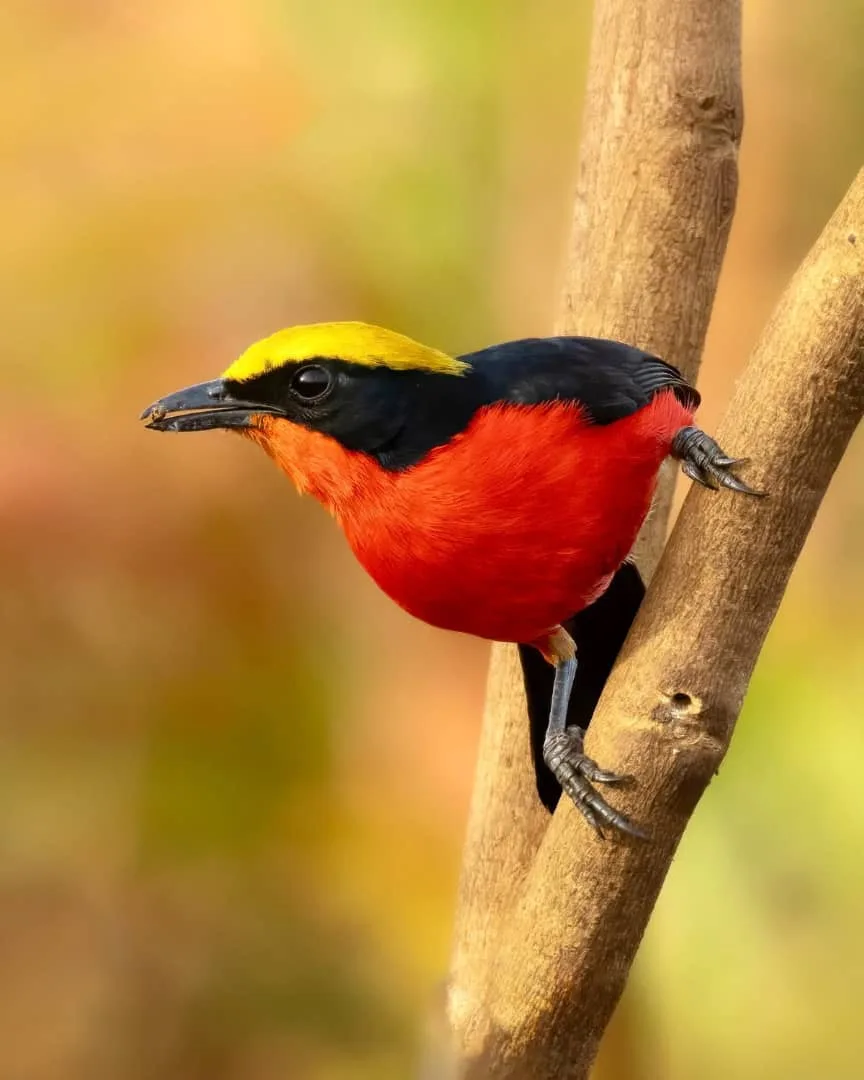
A showy bird that is annoyingly easy to hear and harder to see. It is 22 cm long and described as a common resident breeding bird,[11] but it is a skulking bird of dense undergrowth that often sings in duet.[11] So stand still near thick bushes, listen for whistles and rattles, and wait for the black back, yellow crown and red front to flash. See the Yellow-crowned Gonolek.
In woodland and forest
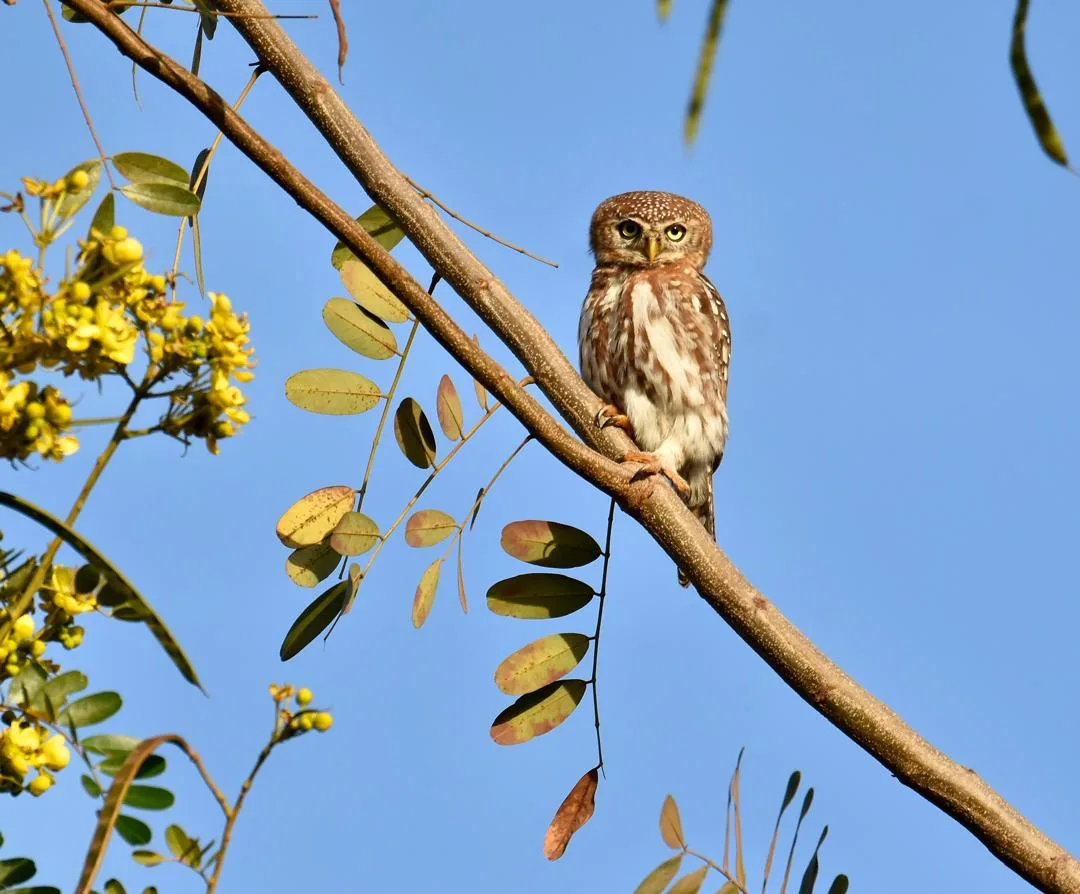
9. Pearl-spotted Owlet
An owl you can see in daylight. It is one of the smallest owls in Africa, 17 to 21 cm long, and it is often active by day even though it hunts and calls mostly at night.[9] Listen for a loud series of shrill, short whistles that speed up,[9] then look in open woodland trees for a small, spotted shape. Its page is Pearl-spotted Owlet.
10. Violet Turaco
We first planned to include the Green Turaco, but its source calls it only inconspicuous in the treetops, so we chose its violet cousin instead. The Violet Turaco is about 48 cm long and locally common, with crimson flight feathers that flash in flight.[13] Groups tend to hop along branches rather than fly,[13] and a good place to try is Abuko Nature Reserve, where it is recorded.[1] Learn more on the Violet Turaco page.
How to start on your first morning
Pick a place with water and bushes, such as a hotel garden, and go early, when birds are active and the air is cooler. Spend your first twenty minutes just standing still. You will see far more by waiting than by walking.
Once you have ticked a few off, a local guide helps you find the shy and the unfamiliar. Abuko Nature Reserve is a gentle place to practise, and our birding itineraries show how a full day is shaped.
Frequently asked questions
What are the easiest birds to see in The Gambia?
Pied Kingfisher, Little Bee-eater, Long-tailed Glossy Starling and Red-cheeked Cordon-bleu are good first targets: all four are described as common in sources, and the first three are also conspicuous.[2][3][4][5]
Are Gambian birds easy to spot for a beginner?
Often, yes. A Gambian guide says that even for the amateur, birds are fairly easy to spot, being conspicuously coloured and vocal.[1]
Do I need binoculars to see these birds?
They help a lot with the small and shy species such as the cordon-bleu and gonolek. Several of the others, like the starlings and bee-eaters, can often be seen well from a few metres away.
Can I see these birds at any time of year?
Yes. All ten are resident in The Gambia, so none depends on the migration season. Our month-by-month guide explains what changes through the year, and it links to the best time to visit.
The bottom line
Start with the water birds and the garden birds, and add the woodland pair when you have your eye in. By the end of a few mornings, you will recognise all ten on sight.
If you would like help choosing where to go, get in touch. Yaya will reply himself, and can match a trip to the birds on your list.
Go deeper
Birds in this guide
Places to visit
Tours that cover this
References
- [1] Access Gambia. Birdwatching in The Gambia. Accessed 23 October 2026.
- [2] Wikipedia. Pied kingfisher. Accessed 23 October 2026.
- [3] Wikipedia. Little bee-eater. Accessed 23 October 2026.
- [4] Wikipedia. Long-tailed glossy starling. Accessed 23 October 2026.
- [5] Wikipedia. Red-cheeked cordon-bleu. Accessed 23 October 2026.
- [6] Footsteps Eco-Lodge (2026-07-25). Birding for Beginners. Accessed 23 October 2026.
- [7] Wikipedia. African fish eagle. Accessed 23 October 2026.
- [8] Wikipedia. Palm-nut vulture. Accessed 23 October 2026.
- [9] Wikipedia. Pearl-spotted owlet. Accessed 23 October 2026.
- [10] Wikipedia. Purple starling. Accessed 23 October 2026.
- [11] Wikipedia. Yellow-crowned gonolek. Accessed 23 October 2026.
- [12] Bradt Guides. The Gambia's best birdwatching sites. Accessed 9 October 2026.
- [13] Wikipedia. Violet turaco. Accessed 23 October 2026.
Photographs by Yaya Barry, taken in the field in The Gambia and Senegal.
Keep reading
Birds for beginners
Birdwatching in The Gambia for Beginners: Your First-Timer's Guide
New to birding? See why The Gambia is one of the easiest places to start: the birds you'll meet, when to go, what a day looks like and how a guide helps.
9 October 2026 · 8 min read
Planning your trip
The Best Time to Go Birdwatching in The Gambia, Month by Month
When is the best time to go birdwatching in The Gambia? A month-by-month guide to migrants, breeding plumage, heat and rain, so you can pick the right season.
13 October 2026 · 7 min read